
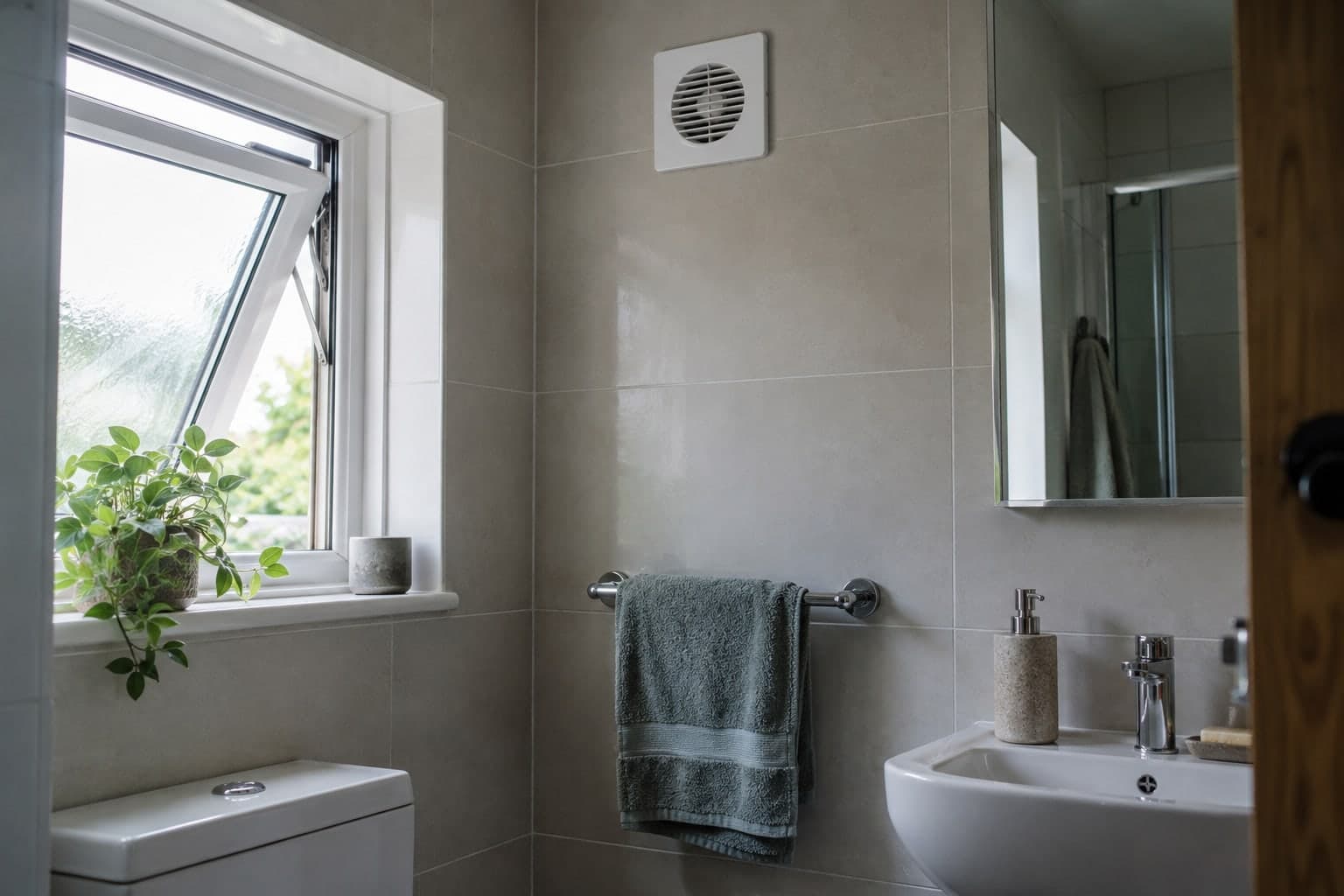
The single most reliable way to stop mould growing in a rental property is to ensure moist air can leave before it condenses on surfaces. That is what ventilation does - it keeps the indoor moisture load low enough that walls, ceilings and window reveals stay above the dew point of the air around them. Without it, the moisture that tenants generate every day from cooking, bathing, drying clothes and simply breathing has nowhere to go. It settles on the coldest surfaces and creates the conditions mould needs.
So how much ventilation is actually enough? The honest answer is: more than most older properties currently have. Part F of the Building Regulations sets minimum ventilation standards for new and significantly refurbished properties, but the bulk of the UK rental stock predates these requirements or has had insulation and double-glazing added without the ventilation upgrade to match. Sealing up a draughty property without adding controlled ventilation is one of the most common triggers for a mould problem that was not there before.
This guide covers the types of ventilation that matter, the most common failures landlords should look for, and what actually fixes the problem. It is aimed at landlords, letting agents and property managers dealing with recurring mould across their portfolio. This is general guidance, not legal advice.
Why ventilation controls mould
Mould needs three things: moisture, a surface to grow on, and a temperature range it can tolerate. Landlords cannot control which surfaces exist or the temperature of an occupied property. But they can control moisture - and the primary mechanism for doing that is ventilation.
The indoor moisture load in a typical property comes from several sources. Cooking contributes a significant daily amount, particularly with no fan to remove steam from the hob area. Bathing and showering introduce hot, moisture-laden air that needs removing at source. Drying clothes indoors is one of the largest single-event moisture loads in a typical household. Breathing and perspiration overnight are modest but continuous, particularly in a closed bedroom, which is why bedrooms are one of the most common rooms for mould. Any underlying damp from the building itself adds to this baseline.
If that moisture stays in the air long enough to reach a cold surface - an external wall, a window reveal, the back of a wardrobe pushed against an outside wall - it condenses. That liquid water is what mould feeds on, and separating condensation from penetrating damp or a leak is the first job in any diagnosis. Ventilation removes the moisture before it can condense by introducing drier outdoor air and exhausting the moist indoor air, usually at the points of highest generation.
The three types of ventilation in a property
Effective ventilation in a home works in layers. Each layer does a different job, and gaps in any one of them leave moisture with somewhere to accumulate.
Background ventilation - trickle vents
Trickle vents are the narrow slotted openings above double-glazed window frames, designed to allow a slow, quiet, continuous flow of outside air into habitable rooms without a cold draught. They are probably the most commonly sabotaged form of ventilation in the UK rental stock: painted shut during redecoration, blocked with draught excluders, or simply absent from older frames that predate the requirement.
When trickle vents are open and working, a property breathes continuously even when occupants keep windows closed in winter. When they are shut or absent, that background exchange disappears and moisture levels climb steadily through the day.
Checking and clearing trickle vents is one of the simplest, cheapest steps a landlord can take - and the one most likely to be undone at the next decoration. It is worth noting in your maintenance records so it is checked at each inspection.
Extract ventilation - extractor fans
Extractor fans in kitchens and bathrooms remove moisture at source - the point where most indoor moisture is generated and where concentrations are highest. Part F of the Building Regulations sets minimum extract rates for wet rooms.
Intermittent fans, switched on by the occupant or wired to the light, are standard for most wet rooms. Humidity-controlled fans, which switch on automatically when relative humidity rises above a set threshold, are more reliable in practice because they operate regardless of what the occupant remembers to do. In bathrooms this matters most during and after showers.
One very common installation error is a fan that vents into the roof void rather than to outside. It deposits the moisture into the loft space, where it condenses on cold surfaces and causes the same problems it was meant to prevent. Extract fans must terminate outside the building envelope - through an external wall or via a correctly routed duct to a roof or soffit terminal.
A recirculating cooker hood above a hob is another common gap. It removes odour and grease through a filter but returns the moisture to the kitchen air. Unless there is a separate fan extracting to outside, the hob is generating moisture with no route out.
Purge ventilation - opening windows
Fully opening a window for a short period to rapidly clear moist air after a shower, or to air a room, is a useful supplement - but it cannot substitute for continuous background ventilation. In winter, occupants typically will not open windows for any length of time, which is why properties that rely entirely on open windows develop mould in the colder months - most visibly as mould around the window reveals themselves.
Purge ventilation is best thought of as an emergency refresh. It is not a strategy.
The most common ventilation failures that cause mould
Most recurring mould in rental properties traces back to one or more of these failures:
- Trickle vents painted, blocked or absent - particularly in properties that have had window replacements without anyone opening the trickle vents afterwards.
- Extractor fans that are broken, undersized, or were never installed in the bathroom or kitchen.
- Fans that vent into the loft rather than to outside - depositing moisture into the roof void.
- No kitchen extract above the hob at all, or only a recirculating filter hood that removes smell but not moisture.
- New insulation or draught-proofing applied without adding controlled ventilation - creating a well-sealed property with no way for moist air to leave.
- Long or deep-plan layouts - common in terraced houses converted to flats - where a rear room has no ventilation path from the front of the property and a single window on one face only.
Ventilation solutions that fix recurring mould
The right solution depends on what is missing. Most properties need a combination of improvements rather than a single fix. Where growth has already taken hold, pair the ventilation work with proper damp and mould treatment - improving the air around mould that is still living on the wall does not remove it.
Trickle vents and background ventilators
Clear blocked trickle vents first - it costs nothing and has immediate effect. If frames are old enough to have no trickle vent, retrofitting purpose-made background ventilators into the existing frame is straightforward and inexpensive. This should be the starting point for any property with condensation on windows or walls.
Extract fans in wet rooms
Replacing a broken or absent bathroom or kitchen fan is one of the most cost-effective investments for a mould-prone property. A humidity-controlled fan costs relatively little more than a standard unit and removes the reliance on occupant behaviour. Confirm at installation that the duct terminates outside the building, not into a void.
Positive Input Ventilation
A Positive Input Ventilation (PIV) unit sits in the loft space - or in a hallway cupboard for flats - and introduces a gentle, continuous supply of filtered outdoor air into the property. The slight positive pressure pushes moist indoor air out through normal gaps and openings rather than letting it settle on cold surfaces. PIV is a practical solution for houses where installing a full duct network is not viable, and it improves air quality across the whole property rather than room by room. Most units are quiet, low-energy, and require minimal maintenance.
Mechanical Ventilation with Heat Recovery
Mechanical Ventilation with Heat Recovery (MVHR) systems supply fresh air and extract stale air across the whole property through a duct network, recovering most of the heat from outgoing air in the process. They are more expensive to install and work best in well-sealed properties - typically new builds or properties undergoing major renovation. For most existing rental stock, PIV or improved local extract ventilation is more practical and significantly cheaper.
What the law says about ventilation in rental properties
Landlords have a legal duty to keep the installations for ventilation in their properties in repair. Under Section 11 of the Landlord and Tenant Act 1985, this covers the structure and installations including those for ventilation - broken extractor fans and blocked or missing trickle vents are not simply cosmetic issues.
The Homes (Fitness for Human Habitation) Act 2018 requires that a property remain fit to live in throughout the tenancy. Persistent damp and mould caused by inadequate ventilation is explicitly relevant to whether a property is fit for habitation.
The Housing Health and Safety Rating System (HHSRS) allows local councils to inspect and rate hazards. Damp and mould linked to ventilation failures can be rated as a Category 1 hazard - the level at which councils have a duty to take enforcement action. They can issue improvement notices requiring specific works.
Maintaining ventilation is an ongoing duty, not a one-off at the start of a tenancy. An extractor fan that breaks during the tenancy and is not repaired, or trickle vents that are sealed over during redecoration, represent a failure of the landlord's repairing obligation.
This is general guidance, not legal advice. If you are dealing with an enforcement notice or a disrepair claim relating to ventilation, take advice specific to your situation.
We carry out ventilation assessments and install trickle vents, extract fans, and PIV systems for landlords, letting agents, housing associations and councils across London and the South of England. We hold Constructionline Gold accreditation, are fully insured, and have completed over 8,500 jobs. Any mould work we carry out comes with a 12-month guarantee. A photo on WhatsApp is the fastest way to get started.
If you need a hand, Simpled Services can help. Call us on 020 4571 7367, message us on WhatsApp at the same number (020 4571 7367), or email hello@simpledservices.co.uk and we will take it from there.