
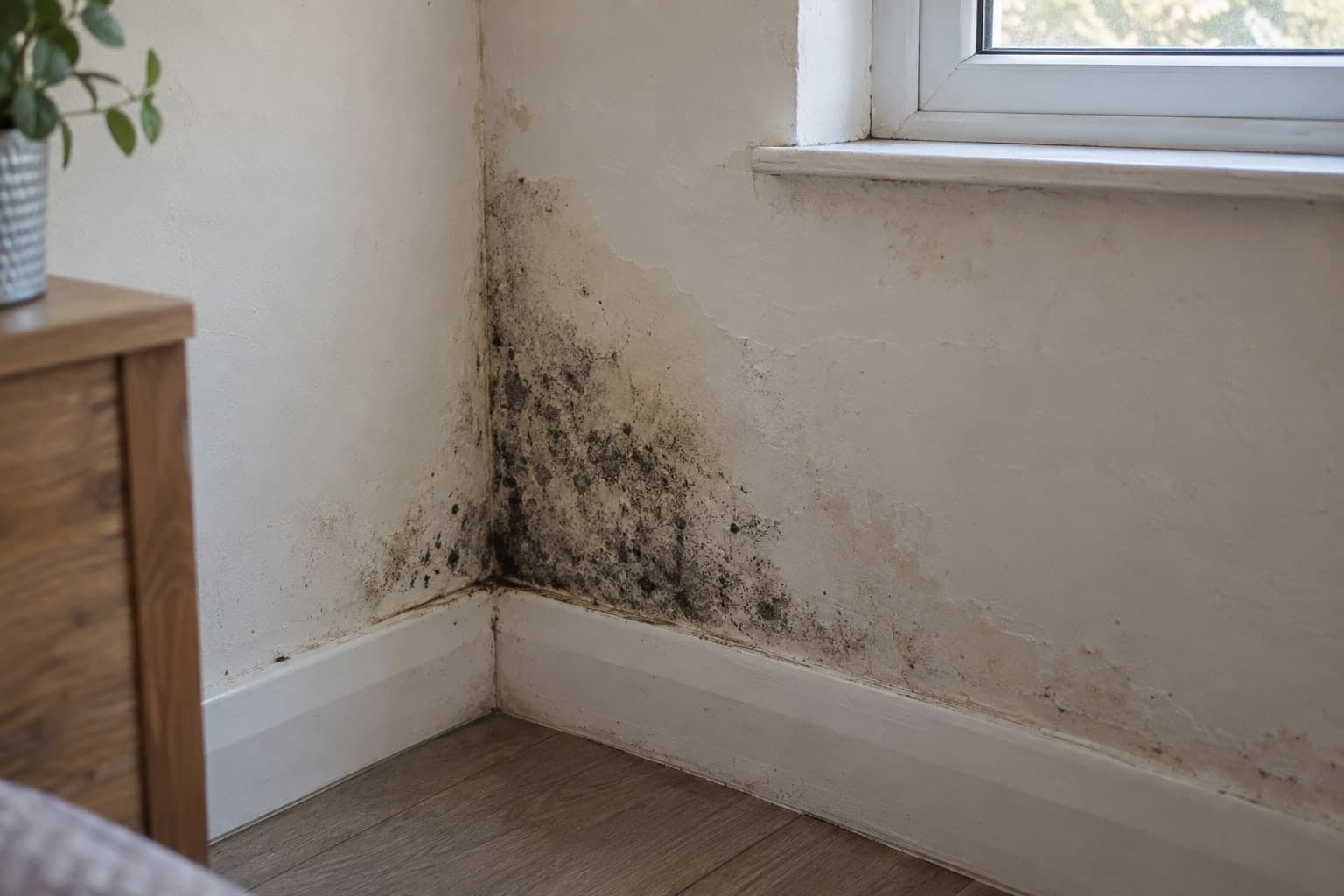
Mould keeps coming back because cleaning removes the visible growth but leaves the moisture source completely untouched. Mould spores are present in the air of every building - they settle on surfaces continuously. The only reason they take hold and form a visible colony is that the surface stays damp enough, for long enough, for growth to begin. Clean the mould without fixing what is keeping that surface damp and you simply reset the clock. Within weeks, sometimes days, the same patch is back - often darker and larger than before.
This is the cycle most landlords and property managers recognise: a clean, a repaint, a complaint, another clean, another repaint. The mould never fully goes because the fix applied is the wrong one. Understanding the actual cause is the step that breaks the cycle permanently.
Surface cleaning removes the mould, not the cause
When you clean mould off a wall - whether with a household bleach spray, a proprietary mould cleaner, or a fresh coat of paint - you are dealing with the symptom, not the problem. The visible mould is the end product of a process that starts with moisture. If that moisture remains, new mould spores settle and begin the same process again in the same location, because the same conditions are present.
Many people assume that mould returns because the cleaning was not thorough enough. In reality, the cleaning is rarely the issue. Even a properly executed fungicidal wash that kills all visible mould down to the surface is just a starting point. Without addressing what made the surface damp, the spores already in the air will land and find ideal conditions again within weeks.
The surface that mould grew on is cold and damp because something is making it cold and damp. That is the problem to solve. Our guide on how to get rid of black mould on walls for good covers the step-by-step treatment method, but treatment without addressing the cause is only ever half the job.
The most common moisture sources behind recurring mould
Condensation on cold surfaces
Condensation is the most common driver of recurring mould in UK homes. Warm, moisture-laden air - from cooking, showering, breathing, and drying clothes - hits a cold surface and deposits moisture. If that surface cannot dry out before more moisture arrives, mould follows. This is why mould is so common on external walls, in corners where two cold walls meet, behind large pieces of furniture, and on window reveals - the coldest points in most rooms.
The moisture itself comes from everyday life and cannot be eliminated. What can be changed is how well the property handles it - through better ventilation, warmer surfaces from improved insulation, and consistent background heating. Our guide to what causes mould in a house explains the condensation cycle and the structural fixes that break it.
Poor or blocked ventilation
A room that cannot effectively exhaust moisture-laden air is a room that will have recurring mould. Bathrooms and kitchens generate the most moisture, and the most important single change in most cases is a working, correctly-sized extractor fan used consistently. A fan that has failed, is blocked with dust and grease, or discharges into a loft void rather than outside is not doing its job - and a broken extractor fan in a bathroom is a repairing obligation on the landlord, not an optional upgrade.
Blocked trickle vents painted shut during redecoration, furniture pushed against walls blocking natural air circulation, and rooms sealed tight for energy efficiency without mechanical ventilation all contribute to moisture that has nowhere to go and deposits wherever it finds a cold surface.
Hidden leaks
Mould that returns to exactly the same small spot very quickly, or that appears despite genuinely good ventilation and reasonable surface temperatures, often has a leak behind it. Water from a dripping pipe joint, a slow overflow, a failing trap under a sink, or a leak from the flat above travels along joists and behind plasterboard and can emerge as mould some distance from the actual source.
Mould driven by a hidden leak behaves differently from condensation mould. It tends to keep a fixed footprint concentrated around one point, it often appears darker and wetter, and it does not respond to ventilation improvements the way condensation mould does. If the same patch returns within two to three weeks of proper cleaning, even in a well-ventilated room, a hidden leak is worth investigating before concluding the problem is condensation.
Penetrating and rising damp
Mould on lower sections of external walls - particularly with a tidemark and salt deposits in the plaster - may indicate rising damp. Mould spreading outward from a fixed point on an external wall, often at a point where mortar has failed or render has cracked, suggests penetrating damp. Both are structural problems that ventilation alone cannot fix. They require investigation with a damp meter and appropriate remediation - repointing, render repair, or damp-proofing - before mould treatment will hold.
Why bleach and standard paint make it worse
Two approaches are so common and so consistently ineffective that they deserve a direct mention.
Bleach - household sodium hypochlorite - lightens the staining on mould but does not kill the full mycelium, the root structure beneath the surface of the wall. The surface looks clear for a few weeks. Then the mould pushes back through. A purpose-made fungicidal wash penetrates further and is the right tool for the treatment itself - but even that, done perfectly, does nothing to the moisture driving the growth.
Standard emulsion paint applied over mould, or over a treated but still-damp wall, is perhaps the worst outcome of all. It seals moisture in and gives the mould a slightly warmer, sheltered environment just beneath the paint layer. Mould pushes through within one to two months, usually in a larger and darker patch than the original. Anti-mould paint or primer applied once the wall is bone-dry is a useful secondary barrier - but it is not a substitute for fixing the moisture source. It slows regrowth; it does not prevent it.
What actually stops mould coming back
Breaking the mould cycle requires three things in sequence: proper treatment of the existing mould, identification and fixing of the moisture source, and a protective finish on the dried and treated surface.
- Treat the mould with a professional-grade fungicidal wash, allowing full dwell time before wiping. Do not paint over it before the surface is completely dry.
- Fix the ventilation - a working extractor fan in the bathroom and kitchen, trickle vents that actually open, or a positive input ventilation unit for persistent whole-property condensation.
- Improve surface temperatures where condensation is forming on cold walls - better insulation, consistent background heating, or secondary glazing on cold single-glazed windows.
- Trace and repair any hidden leak before redecorating - this usually requires a plumber or a leak tracer for concealed pipework.
- Address structural damp (penetrating or rising) with the appropriate fix - repointing, render repair, or damp-proofing - before treating the mould above it.
- Once the wall is dry and the cause fixed, apply an anti-mould primer before repainting as a secondary measure.
When to call a professional
If you have cleaned the same patch three or more times and it has returned each time, something has not been diagnosed correctly. A professional mould specialist will take moisture readings at the wall surface and at depth, assess the pattern and location of the growth, look for structural damp and hidden leak indicators, and provide a written diagnosis of what is actually driving it.
For landlords, professional involvement has a second value: documentation. A written inspection report, before-and-after photographs, and a clear record of the works carried out give you evidence that you investigated properly and acted on what was found. That record is what protects you if the matter goes to a council inspector, a deposit adjudicator, or a disrepair claim - see our guide to a landlord's legal duties on mould for the full picture of what the law expects.
We treat recurring mould for housing associations, councils, letting agents and private landlords across London and the South of England. Every job includes identification of the moisture source, professional fungicidal treatment, and a written summary of findings and works. The work is backed by a 12-month guarantee - if the treated mould returns within a year, we come back and put it right. We hold Constructionline Gold accreditation, are fully insured, and have completed over 8,500 jobs. The fastest way to start is a photo on WhatsApp.
If you need a hand, Simpled Services can help. Call us on 020 4571 7367, message us on WhatsApp at 07577 772425, or email hello@simpledservices.co.uk and we will take it from there.