
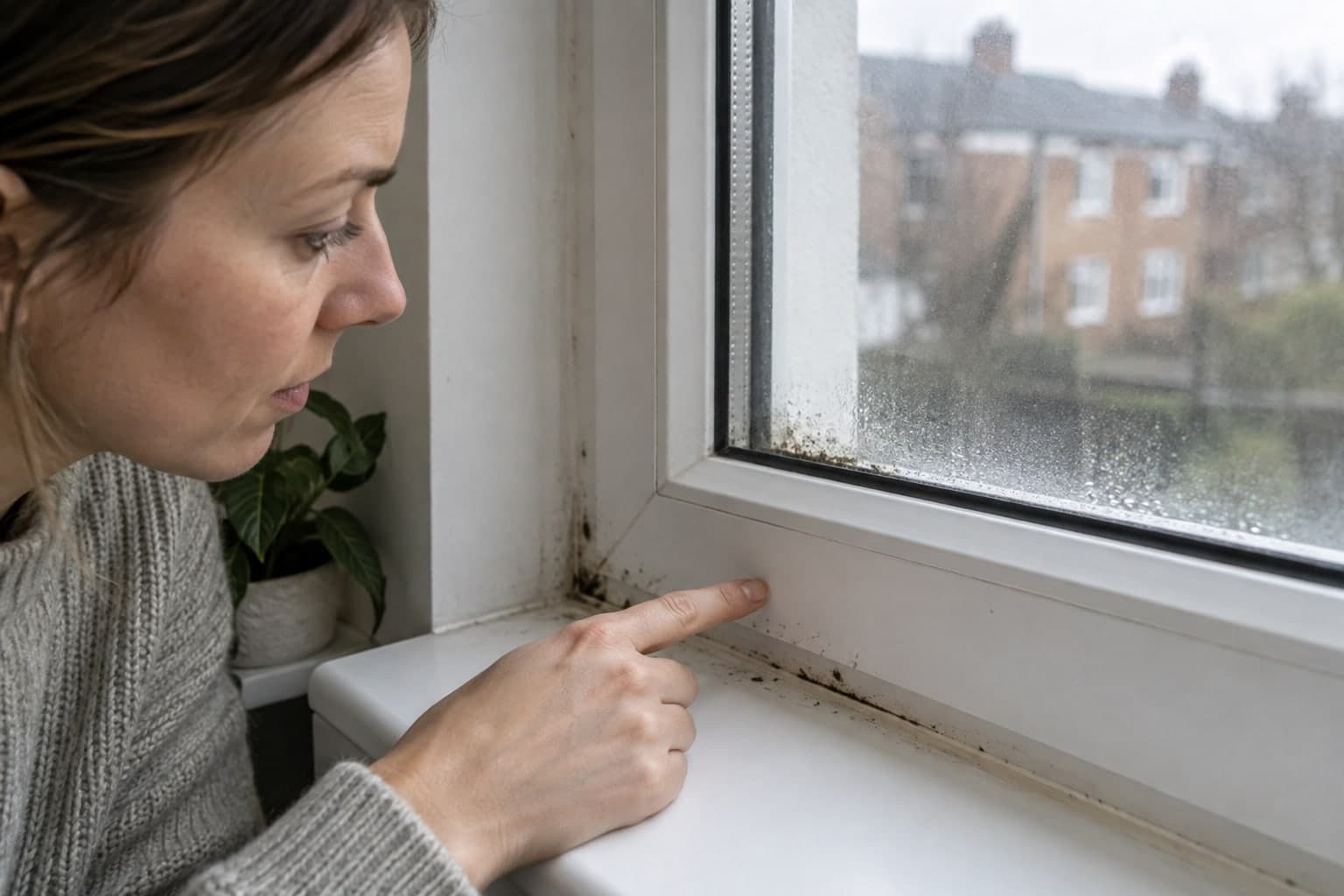
Mould around windows is one of the most common maintenance complaints we see across rental properties in London and the South of England. It usually appears as black specks or a dark smear along the bottom of the frame, in the corners of the reveal, or on the wall just beside the window - and it often comes back a few weeks after tenants wipe it away.
The good news is that window mould is usually caused by condensation, and condensation can be addressed. The bad news is that painting over it or asking tenants to wipe it down does not work. You need to understand why condensation is forming there and deal with that, or the mould will keep returning. For the wider set of triggers we see across a property, see our guide on what causes mould in a house.
Why mould forms around windows
Windows are the coldest surface in most rooms. When warm, moist air inside the property meets cold glass or a cold frame, the moisture in the air drops out as condensation - water droplets on the surface. If that condensation sits on the frame, the sill or the surrounding plaster long enough, mould spores settle in and begin to grow.
The trigger is almost always condensation. Even where there is a genuine damp problem in the wall, condensation on the window reveals makes it worse. Understanding which you are dealing with matters, because the fix is different.
- Single-glazed or older double-glazed windows that have lost their gas fill are far colder and produce much more condensation than modern units.
- uPVC frames can trap condensation in the seal between the frame and the wall reveal if the mastic has failed.
- Timber frames absorb moisture and are slower to dry, giving mould longer to establish.
- North-facing windows get less sun and stay colder for longer - they are almost always the worst affected.
- Trickle vents blocked by tenants or siliconed shut by a previous contractor mean there is nowhere for moist air to escape.
Condensation mould vs a damp or leak problem
Before you treat it, establish the actual cause. Condensation mould sits on the surface - it wipes off, it is powdery or slightly fuzzy, and it tends to be worst in winter and in high-moisture rooms. A damp or leak problem behind the wall shows as staining that bleeds through paint, a tide mark, or plaster that is soft and crumbling. The wall feels wet to the touch even after a dry spell. Our full breakdown of black mould vs condensation mould covers the visual differences in more detail.
Window-level damp that is not condensation is usually one of a few things: a failed lintel letting water track down the reveal, a gap in the flashing above the window, or a silicone seal that has split and is letting rainwater behind the frame. These need a proper investigation rather than ventilation improvements.
How to tell condensation from penetrating damp
- Condensation mould: worst in cold months, clears in summer, appears on the surface, no staining behind the plaster.
- Penetrating damp: present in wet weather regardless of season, staining comes back through fresh paint, plaster soft or hollow, may have a waterline.
- Failed seal or flashing: wet patch appears after rain, tracks down from the top of the frame, often just one corner of the window.
The permanent fix for window condensation mould
If the cause is condensation, the fix has two parts: reduce the moisture in the air and raise the surface temperature of the window and surrounding fabric. Doing only one of these rarely works long term.
Improve ventilation first
Ventilation is the single most effective lever. A bathroom or kitchen extractor fan that is slow, blocked or vented into the loft rather than outside adds an enormous amount of moisture to the air that has to go somewhere. Check that:
- Extractor fans in bathrooms and kitchens are working properly and ducted to outside - not into a loft void.
- Trickle vents in window frames are open and clear. These are the small slots at the top of a uPVC frame and they do a lot of work.
- Any positive input ventilation (PIV) unit is serviced and the filters are clean.
- There is background ventilation in bedrooms - airbrick, trickle vent or passive wall vent.
Address cold surfaces
If the glazing is old single-pane or failed double-glazing, the window itself will always condense heavily regardless of how well the property is ventilated. Replacing failed units with modern A-rated double or triple glazing is not always a quick fix, but it is the only lasting solution where the glass temperature is the problem.
Similarly, uninsulated reveals - the plaster-lined recess between the frame and the room - can be cold enough to condensate even when the glass is fine. Adding a thin layer of insulated plasterboard to the reveal (a relatively quick job) raises the surface temperature and stops the moisture dropping out there.
Treat the mould and prepare the surface properly
Once ventilation is improved and surface temperatures are addressed, the existing mould needs to be removed correctly before any redecorating. This means:
- Kill the mould with a proper fungicidal treatment - not just a wipe with diluted bleach, which leaves the root structure in the plaster.
- Allow the wall to dry fully before applying any paint.
- Use a specialist mould-resistant paint on the affected area - standard emulsion will fail again within months.
- Re-seal any failed mastic around the window frame with a new bead of silicone to prevent moisture getting behind the frame.
What does not work
Landlords and agents sometimes try shortcuts that look like a fix but are not:
- Painting over mould without killing it first - the mould grows back through the paint within weeks.
- Telling tenants to open windows - helpful up to a point, but if the building lacks extraction and has cold surfaces, it will not solve the problem.
- Sealing trickle vents or gaps with silicone to 'stop draughts' - this removes the ventilation the building needs and makes condensation significantly worse.
- Replacing mastic without improving ventilation - the new seal looks better but the moisture problem continues and the mould reappears elsewhere.
What landlords should do when a tenant reports it
Under your repairing obligations, you are responsible for keeping the structure, heating and ventilation installations in working order. Where condensation mould is caused by inadequate ventilation or cold surfaces that are part of the building fabric - failed glazing, cold reveals, broken extractor fans - fixing it is your responsibility, not the tenant's.
The practical steps when mould around windows is reported:
- Inspect promptly and look beyond the mould itself - check the extractor fans, trickle vents, condition of the glazing and the state of the mastic seal.
- Establish whether it is condensation or a leak/damp issue - the investigation approach and the fix differ.
- Arrange proper treatment and the underlying fix, not just a surface clean.
- Keep a record of what you found and what was done - this matters if the tenant later makes a complaint.
Mould that returns after repeated treatment is a clear signal that the underlying cause has not been addressed. Continuing to clean the surface rather than fixing the source will not meet your obligations and is likely to result in a disrepair complaint.
How Simpled Services approaches window mould
We treat the cause, not just the surface. When we attend a property for mould around windows, we check the ventilation (extractor fans, trickle vents, general air flow), the condition of the glazing and seals, and the thermal performance of the reveal before we recommend a course of action. Where condensation is the driver, we fix the ventilation and the surface together, treat the mould correctly, and redecorate with mould-resistant materials. Our 12-month guarantee covers the treated area - if the mould returns within that period, we come back.
We work with letting agents, housing associations, councils and private landlords across London and the South of England and have completed over 8,500 jobs, many of them repeat maintenance programmes where the first contractor's surface treatment simply did not hold. Send us a photo on WhatsApp and we can usually give you a clear indication of what is needed before we even visit.
If you need a hand, Simpled Services can help. Call us on 020 4571 7367, message us on WhatsApp at the same number (020 4571 7367), or email hello@simpledservices.co.uk and we will take it from there.