
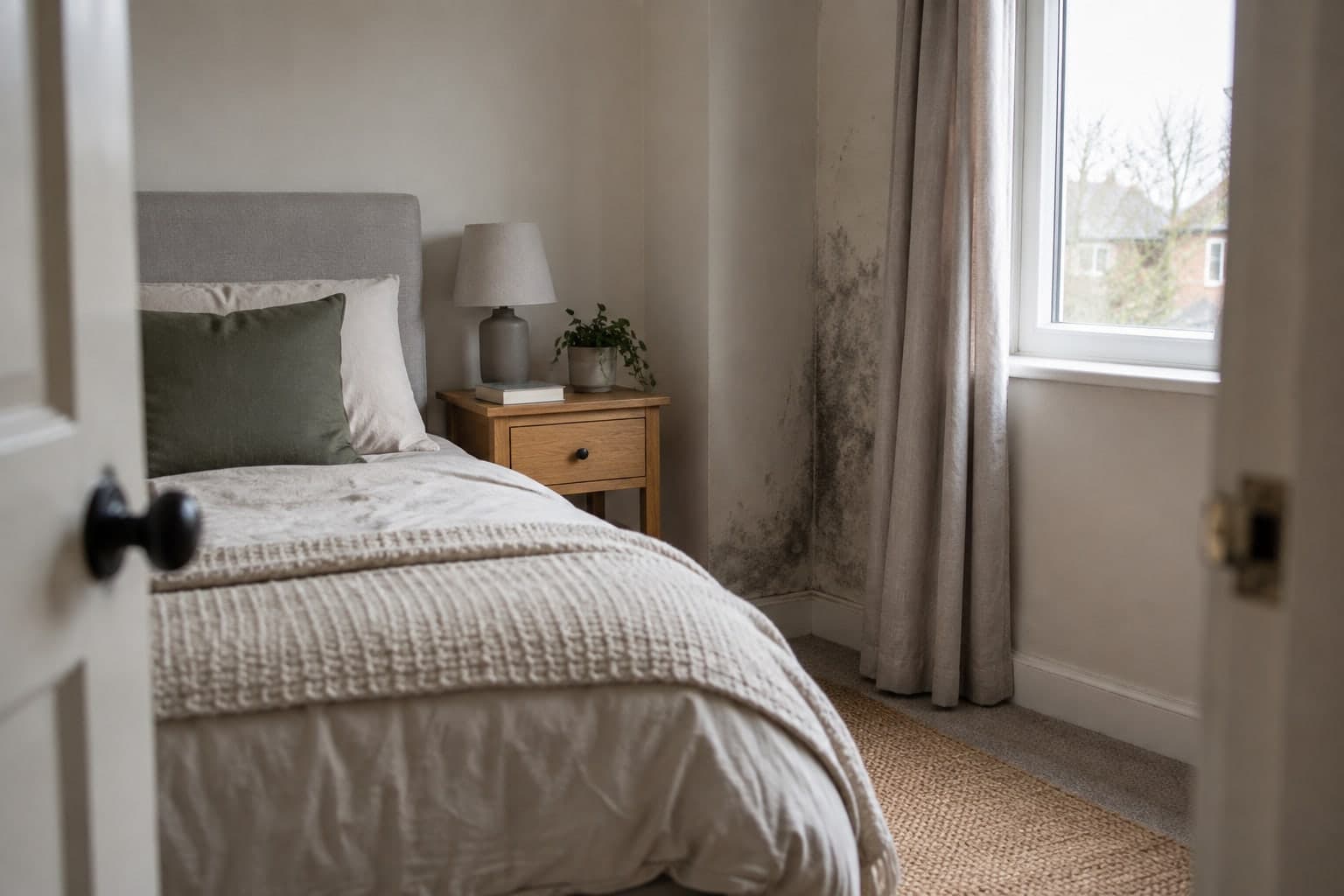
Mould in a bedroom is not just a cosmetic problem - it is a sign that moisture is building up in a space where people spend seven to nine hours every night. A couple sleeping in a closed bedroom can release close to a litre of water vapour into the air overnight simply from breathing. If the room is poorly ventilated or the walls are cold enough to condense that moisture, mould will follow. The question is whether the cause lies in the building or in how the room is used.
For landlords and property managers, that distinction matters legally as much as practically. A property without adequate insulation, ventilation, or heating is structurally predisposed to bedroom mould - and courts, councils, and inspectors have consistently placed responsibility for those underlying conditions on the landlord. A tenant who does not open windows cannot override cold walls and a broken extractor fan.
This guide explains why bedrooms are particularly prone to mould, how to identify whether the cause is condensation, damp or a leak, and what a proper fix looks like. It also covers the legal position briefly - this is general guidance, not legal advice.
Why bedrooms are especially prone to mould
People tend to think of kitchens and bathrooms as the main sources of indoor moisture. They are - but they are also more likely to have extractor fans and ventilation that, at least partly, removes that moisture. Bedrooms are a different problem. The moisture source is quieter and continuous - hours of breathing and perspiration from sleeping occupants - and the room is usually closed off from the rest of the property overnight.
Sleeping occupants release significant moisture
A single person asleep generates roughly half a litre of moisture overnight through breathing and perspiration. Two people in a closed room can release close to a litre. In a well-insulated, well-ventilated room that moisture disperses. In a bedroom with a cold external wall, sealed trickle vents, and a door kept shut all night, it settles on the coldest available surfaces - usually the external wall, the window reveal, or the corner where two cold walls meet.
Cold walls and thermal bridging
External bedroom walls in older or poorly insulated properties often have an internal face that stays cold enough to cause condensation, even with normal indoor temperatures. At window reveals, behind skirting boards, and at the junction of walls and ceilings - points known as thermal bridges - the wall surface drops below the dew point of the room air. That is where moisture deposits and mould begins.
Properties with single-skin solid walls, uninsulated cavity walls, or poor fitting around windows and doors are structurally prone to this. Bedroom mould in these properties tends to appear first at the corners of external walls, along the top of the skirting board, and around window frames - all locations where the wall is coldest.
Beds placed against external walls
A bed pushed against an external wall creates a sealed pocket of air between the mattress or headboard and the wall. That air cannot circulate, the wall behind it stays cold and damp, and mould develops in exactly the shape of the concealed area. When the furniture is moved out, landlords frequently find mould that has been growing unseen for months or years. It is one of the most common patterns in bedroom mould reports, and it is almost always a building problem rather than a tenant negligence issue - the wall is cold because it is poorly insulated.
Doors kept closed and limited through-ventilation
A bedroom with the door shut overnight has no fresh air coming in and no moist air leaving. Trickle vents in windows - the narrow slotted openings above the main frame - exist precisely to allow slow background ventilation even with windows closed. In many older properties they are painted shut during redecoration or simply absent. Without them, a closed bedroom relies entirely on occupants opening windows, which in winter they typically do not.
Is the mould structural or lifestyle-driven?
This is the question landlords most commonly ask, and the answer usually requires a closer look at the room rather than an assumption in either direction. The pattern and location of mould gives strong clues.
- Mould on external walls, in corners, behind furniture, or around window reveals - particularly at thermal bridge points - points to cold walls and inadequate insulation or heating. This is a structural issue.
- Mould appearing directly above a window where condensation has been running down - particularly if trickle vents are blocked or absent - points to inadequate ventilation infrastructure. Also structural.
- Mould concentrated on a single small patch and returning within two to three weeks of proper cleaning may indicate a hidden leak behind the wall - a slow drip from a pipe joint or a failed seal elsewhere in the building.
- Mould spreading widely across multiple rooms in a short time, in a property that is otherwise structurally sound and well-ventilated, may reflect high moisture loads from behaviour - extensive clothes drying, very long showers with no extraction, or a very high occupancy level for the floor area.
- When in doubt, take moisture readings at the wall surface and at depth. Surface damp that does not penetrate more than a few millimetres is usually condensation. Damp that goes deeper often indicates penetrating moisture or a structural leak.
How to fix bedroom mould properly
Cleaning the mould without addressing the cause is the single most reliable way to ensure it returns. The fix has to work on two levels - treatment of the existing growth, and removal of the condition driving it.
- Treat existing mould with a purpose-made fungicidal wash, not neat bleach. Bleach lightens the staining but does not kill the mycelium (the root structure in porous walls), which is why mould returns quickly after bleach treatment. Use the wash at the stated concentration, allow it to dwell for the full contact time, then wipe off and ventilate fully.
- Do not apply any finish - paint or otherwise - until the wall is completely dry. Sealing a damp wall traps moisture and produces a return patch that is larger and darker than the original.
- Check and clear trickle vents above windows. If they are painted shut, open them and test that they move freely. They are ventilation, not a draught problem.
- If the room has no background ventilation path - no trickle vents and no extractor - consider whether a humidity-controlled ventilation unit is appropriate. These run automatically when relative humidity rises above a threshold, removing moist air without relying on occupant behaviour.
- Check heating in the bedroom. A room left unheated for long periods will have cold walls that condense moisture far more readily. Background heating - even a low setting - keeps wall surface temperatures above the dew point far more effectively than heating the room quickly just before use.
- If the mould is behind where a bed was pushed against an external wall, pull the bed out and leave a gap of at least 50mm between the mattress or headboard and the wall. This allows air to circulate and is the simplest immediate step.
- If mould is returning quickly despite good ventilation, take a moisture reading at the affected area. If the reading is elevated at depth, investigate for a structural leak or penetrating damp before re-treating.
- Once the wall is dry and the cause fixed, apply an anti-mould primer before repainting. This slows regrowth but is not a substitute for fixing the moisture source.
What the law expects of landlords
This is general guidance, not legal advice - but the legal framework for bedroom mould is clear in outline.
Under Section 11 of the Landlord and Tenant Act 1985, landlords of shorter residential tenancies must keep the structure and exterior of the property - including walls, windows, and installations for ventilation and heating - in repair. A bedroom wall that is cold because cavity insulation is absent, or a window with no trickle vent, is a structural condition for which the landlord is responsible.
The Homes (Fitness for Human Habitation) Act 2018 requires that the property remains fit to live in throughout the tenancy. Serious damp and mould - particularly in a room where occupants sleep - is one of the conditions explicitly cited as potentially making a property unfit. A tenant can bring a county court claim under this Act.
Awaab's Law currently applies to social landlords only. It came into force in October 2025 and imposes strict timescales for investigating and fixing damp and mould in the social rented sector. As of August 2026, there is no confirmed commencement date for its extension to private landlords - but the Renters' Rights Act 2025 contains the power to extend it, and landlords should treat it as the direction of travel.
The Housing Health and Safety Rating System (HHSRS) allows local councils to inspect and rate the severity of hazards including damp and mould. A Category 1 hazard gives the council a duty to take enforcement action. Bedroom mould in a child's room, or in a room occupied by a vulnerable or elderly person, is more likely to be rated at the higher category.
When to call a professional
If the bedroom mould has returned three or more times after cleaning, or if you cannot confidently identify the cause, a professional assessment makes sense both practically and for your records. A specialist will take moisture readings at the wall surface and at depth, assess the pattern and extent of growth, check for hidden leaks, and provide a written diagnosis. That documentation matters if the matter is ever escalated to an environmental health officer, a deposit adjudicator, or a disrepair claim.
We treat bedroom mould and investigate its causes for private landlords, letting agents, housing associations, and councils across London and the South of England. Every job includes professional fungicidal treatment, identification of the moisture source, and a written summary of findings. We hold Constructionline Gold accreditation, are fully insured, and have completed over 8,500 jobs. The work is backed by a 12-month guarantee - if the treated mould returns within a year, we come back and put it right. A photo on WhatsApp is the fastest way to get us started.
If you need a hand, Simpled Services can help. Call us on 020 4571 7367, message us on WhatsApp at the same number (020 4571 7367), or email hello@simpledservices.co.uk and we will take it from there.