
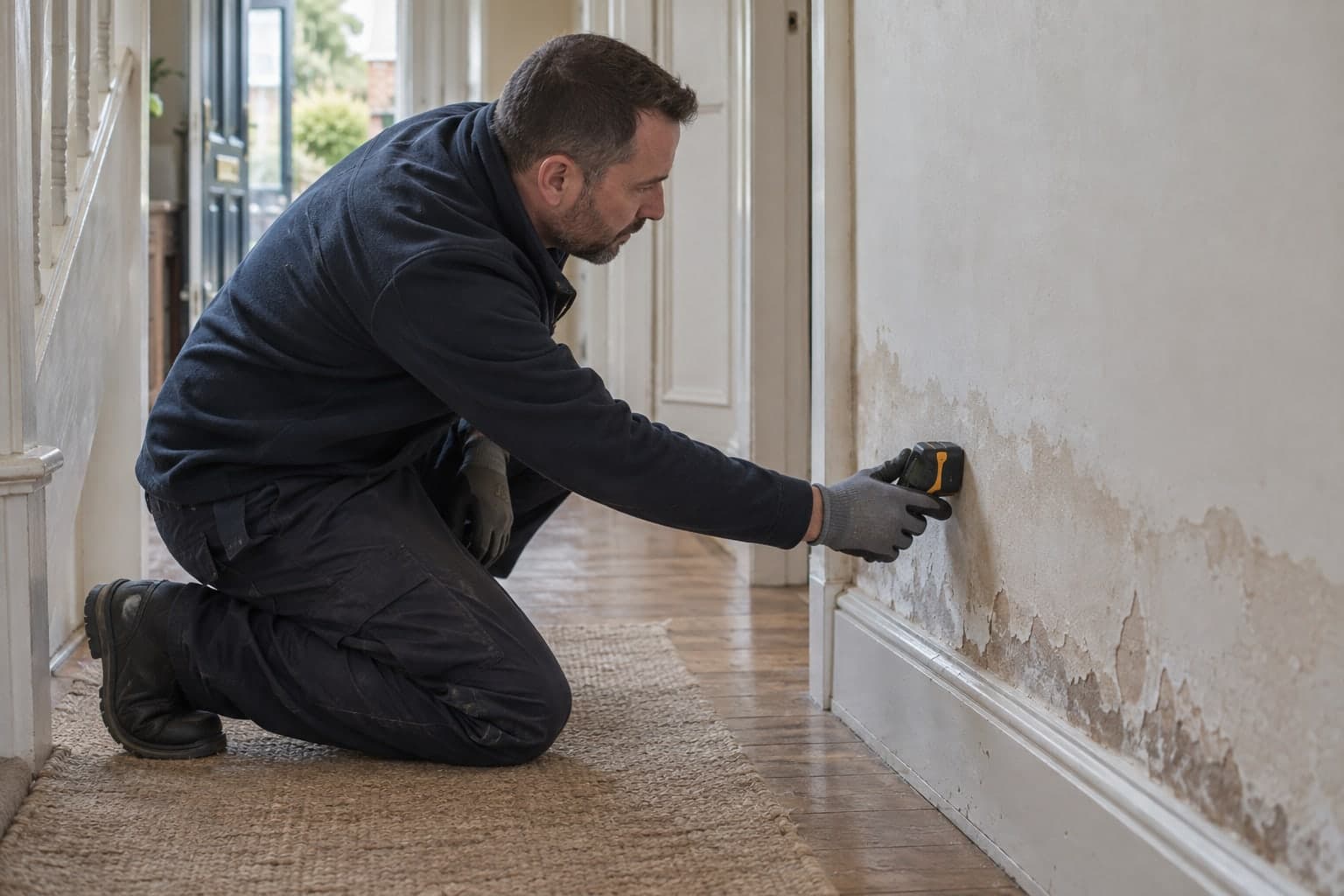
Rising damp and penetrating damp are the two most common structural moisture problems in UK rental properties - and they are frequently confused with each other. The key difference is direction: rising damp is ground moisture travelling upward through porous masonry, while penetrating damp is water entering horizontally through defects in the building fabric. They look similar on a wall, but they have entirely different causes and require entirely different fixes. Getting the diagnosis wrong means paying to treat the wrong problem.
Misdiagnosis is more common than it should be. Some damp survey companies have historically over-diagnosed rising damp because the treatment - DPC injection and replastering - is profitable. In reality, a large proportion of what gets labelled 'rising damp' turns out to be penetrating damp, condensation, or a combination of the two once a proper moisture survey is carried out. For landlords and property managers, the practical lesson is: get an independent diagnosis before commissioning expensive remedial work.
This guide explains what each type looks like, how to distinguish them from each other (and from condensation), which is more expensive to fix, and what landlords should do when they find damp in a let property.
What is rising damp?
Rising damp is ground water being drawn upward through the pores and capillaries of masonry - brickwork, stonework, mortar joints - by capillary action. Every wall sits on ground that contains some moisture, and porous materials naturally absorb it. The damp proof course (DPC) - a horizontal barrier built into the wall near ground level - exists to break that capillary path. When the DPC fails, is bridged, or was never installed, moisture travels up.
Properties built before the early twentieth century often have no DPC at all, or have a slate or bitumen DPC that has cracked and failed over time. In newer properties, the DPC can be bridged if external ground levels have been raised - a path, a flower bed, or render applied too high can create a continuous path that bypasses the barrier entirely.
Rising damp almost never goes higher than about one metre above floor level. Gravity and evaporation from the wall surface eventually overcome capillary action, which is why you get a characteristic tide mark at that height. If a damp patch is appearing above one metre, it is almost certainly not rising damp.
- Tide mark or 'strandline' on the wall, typically between 300mm and 1 metre from floor level
- White powdery deposits (efflorescence) or salt staining on plaster or brick - the ground salts travel up with the water and are deposited as it evaporates
- Crumbling, powdery, or hollow-sounding plaster at low level
- Peeling paint or wallpaper starting at the base of the wall
- Musty smell at ground level, particularly noticeable in ground-floor rooms against external walls
- Damp that is relatively consistent year-round rather than worsening dramatically in wet weather
What is penetrating damp?
Penetrating damp is water entering the building by passing through the external fabric - through walls, around openings, or via the roof and gutters. Unlike rising damp, it can appear at any height and in any room, because the entry point can be anywhere on the building envelope. The common thread is that there is a physical defect somewhere outside that is letting water in.
Common sources include failed pointing between bricks or stones, cracked or porous render, gaps that have opened up around window and door frames, leaking gutters or downpipes that run water against the wall over weeks and months, damaged or missing flashing at roof junctions, and defective bay or parapet roofs. Each defect creates a damp patch that maps broadly onto its location on the wall.
Penetrating damp often worsens visibly after heavy rain and improves during dry spells - this weather correlation is one of the most reliable diagnostic clues. A patch that appeared during last autumn's wet weather, faded over summer, and is back again now the rain has returned is penetrating damp until proven otherwise.
- Damp patches at any height - on walls, ceilings, or in corners - not just at low level
- Patches that worsen during or after rainfall and improve in dry weather
- Damp concentrated near a specific external defect - a cracked piece of pointing, a failed window sill, a leaking gutter joint
- Dark staining without the white salt deposits that characterise rising damp
- Damp that appears on upper floors or on internal walls adjacent to a flat roof or parapet
- A musty smell that is worse after rain rather than constant throughout the year
How to tell rising damp and penetrating damp apart
The differences are not always obvious from looking at a wall, particularly when a property has been decorated over previous damp damage. These are the most reliable diagnostic indicators:
A professional damp survey using a calibrated moisture meter removes most of the ambiguity. A specialist will take readings at multiple heights on the affected wall and compare them to reference readings on dry walls elsewhere in the building. Penetrating damp shows elevated moisture at the point of entry; rising damp shows a gradient that is highest at floor level and reduces as you go up. The salt test - checking for soluble salts in the plaster - confirms rising damp and rules out penetrating damp.
| Feature | Rising damp | Penetrating damp |
|---|---|---|
| Height on wall | Below ~1m | Any height |
| Pattern | Horizontal tide mark | Irregular patches |
| Salt staining (efflorescence) | Common | Rare |
| Worsens after rain | No | Yes |
| Seasonal variation | Relatively constant | Peaks in wet weather |
| Likely cause | Failed or bridged DPC | Building fabric defect |
What about condensation - and how to rule it out
Condensation is often mistaken for both rising and penetrating damp, and in practice many properties have more than one type of moisture problem running simultaneously. Condensation occurs when warm, humid air meets a surface cold enough that the air can no longer hold its moisture - it deposits as water on that surface. The classic places are external wall corners, surfaces behind large furniture, single-glazed window frames, and cold wall areas near the floor in poorly heated rooms.
Condensation does not produce salt staining or tide marks. It is seasonal - typically worst in October to March - and is directly linked to activities that generate moisture indoors: cooking, bathing, drying laundry. Improving ventilation (particularly in kitchens and bathrooms) and keeping background heating consistent will reduce or eliminate condensation mould. Neither of those measures does anything for rising or penetrating damp.
If damp mould is appearing in corners of rooms at head height, behind furniture, or on windows, condensation is the most likely cause. If it is appearing at low level on external walls with salt staining, suspect rising damp. If it appears after rain on a specific part of a wall or ceiling and tracks a line from outside, investigate penetrating damp first.
Which is more expensive to fix?
Penetrating damp repairs are usually more straightforward and lower cost when caught early, because the fix is targeted at the specific entry point: repoint a section of brickwork, reseal a window frame, clear and repair a gutter, replace flashing. The work is finite and the result is immediate once the wall dries out.
Rising damp treatment involves more work. A DPC injection alone is not enough - the plaster in the affected area will be contaminated with ground salts, and those salts will continue to draw moisture from the air indefinitely. Proper rising damp remediation means hacking off the contaminated plaster, treating the wall, injecting or reinstating the DPC, and re-plastering with a sand and cement render rather than a standard gypsum plaster that the salts will destroy again. This is a more disruptive and more expensive job.
The cost difference is not absolute - a penetrating damp problem affecting a large area of render or requiring scaffold access can cost as much as a rising damp treatment. But as a general rule, catching penetrating damp early and fixing the entry point costs far less than leaving it until the plasterwork needs replacing.
What landlords should do when they find damp
Act promptly and document everything. Damp that is caught at the first signs - a tide mark, a patch that appeared after heavy rain - is a contained repair. Damp that has been ignored for a season or two can mean rotten window frames, damaged floor joists, and a full-scale replaster. The cost difference is significant.
- Photograph the affected area clearly and note the height of any damp patch, whether it worsens after rain, and whether there is any salt staining or crumbling plaster
- Check outside the building for obvious entry points: blocked gutters, cracked pointing, failed render, damaged flashing, or anything where the DPC might be bridged
- Commission a professional damp survey if you cannot confidently identify the cause - a moisture meter survey is the reliable way to distinguish rising damp, penetrating damp, and condensation and to scope the repair correctly
- Fix the underlying cause before redecorating: sealing over a damp patch with paint or new wallpaper traps moisture, accelerates plaster damage, and means the problem returns within months
- Keep a written record of the survey report, the repair specification, and the work carried out - under the Renters' Rights Act 2025 and the Decent Homes Standard framework, landlords who can demonstrate prompt investigation and remediation are in a much stronger position if a tenant complaint arises
- For rising damp, ensure the plaster is replaced with a salt-resistant mix, not just re-skimmed - otherwise the contamination drives recurring damp regardless of the DPC work
How Simpled Services can help
We have completed over 8,500 jobs for landlords, letting agents, housing associations, and councils across London and the South of England, and damp surveys are one of our most common first calls. We carry Constructionline Gold accreditation, are fully insured, and our mould treatment work carries a 12-month guarantee.
If you have found a damp patch, a tide mark, or a persistent musty smell in a property you manage and you are not certain what type of damp you are dealing with, a photo sent on WhatsApp gets you a same-day assessment. We will tell you what we think the cause is, what the fix looks like, and what it is likely to cost - before you commit to anything.
If you need a hand, Simpled Services can help. Call us on 020 4571 7367, message us on WhatsApp at the same number (020 4571 7367), or email hello@simpledservices.co.uk and we will take it from there.