
Mould on walls and ceilings is always communicating something about the moisture in a property - you just need to read the signals. Where it appears, what pattern it makes and how quickly it spreads all point to different causes. Getting that diagnosis right is the only way to stop it coming back.
For landlords and property managers, the location matters even more than the mould itself. Treat the surface without understanding what is driving it and it returns within weeks - usually worse, because the underlying moisture problem has been given more time to develop.
This guide explains what mould in different parts of a property is telling you, what it means for your responsibilities, and what actually needs to happen to resolve it.
What mould on walls is telling you
Wall mould is common but its position within the room is the clue. The same black patches in different locations point to very different problems.
- External wall corners, particularly in north-facing rooms or rooms that feel cold even when the heating is on: this is a cold bridge - a structural weak point where warm, humid room air meets a cold surface and moisture condenses. The corner is colder than the rest of the wall and the mould grows there first.
- Low on external walls, often with a tide mark or softening plaster below: this suggests penetrating damp from outside or, right at ground level, rising damp. It calls for a proper damp investigation, not just mould treatment.
- Around window reveals and below sills: cold glass and frames cause condensation on the surrounding plaster. If the window seal has failed or the wall around it is poorly insulated, the problem runs deeper than the frame itself.
- On an internal partition wall in a room where cooking or laundry takes place: usually condensation building up because warm humid air has nowhere to go. The fix here is ventilation rather than structural work.
Cold spots on external walls - caused by thin insulation, solid walls or absent cavity fill - are one of the most common drivers of recurring mould in rental properties built before the 1980s. The wall itself is the problem, and no amount of anti-mould paint changes that.
What mould on ceilings is telling you
Ceiling mould has two very different origins. The first is condensation rising upwards and settling on the coldest surface in the room. The second is water coming down from above. Telling them apart changes what you do next.
- Bathroom and en-suite ceilings, often covering a wide area: steam from showers and baths rises and condenses on the ceiling. If there is no extractor fan, the fan is blocked or undersized, or it vents into the loft void rather than outside, moisture has nowhere to go. This is the most common form of ceiling mould in residential properties.
- Bedroom ceilings, often in a patch directly above the bed: overnight breathing raises humidity significantly in a closed room. If the room is cool and poorly ventilated, condensation forms on the ceiling above where people sleep. Trickle vents and background ventilation are the straightforward fix.
- Isolated round or oval patches, sometimes near a light fitting or tracking along a joist line: water is working its way down from a roof, a pipe or the property above. The mould may appear some distance from where the water is actually entering.
- Spreading patches with a brown stain or a ceiling that has begun to bubble: this is almost certainly active water ingress, not condensation. It needs investigating from above before anything else.
A ceiling stain that follows a straight line often traces a joist or pipe running above. That is useful information when you are trying to locate a hidden leak - it narrows down exactly where to look.
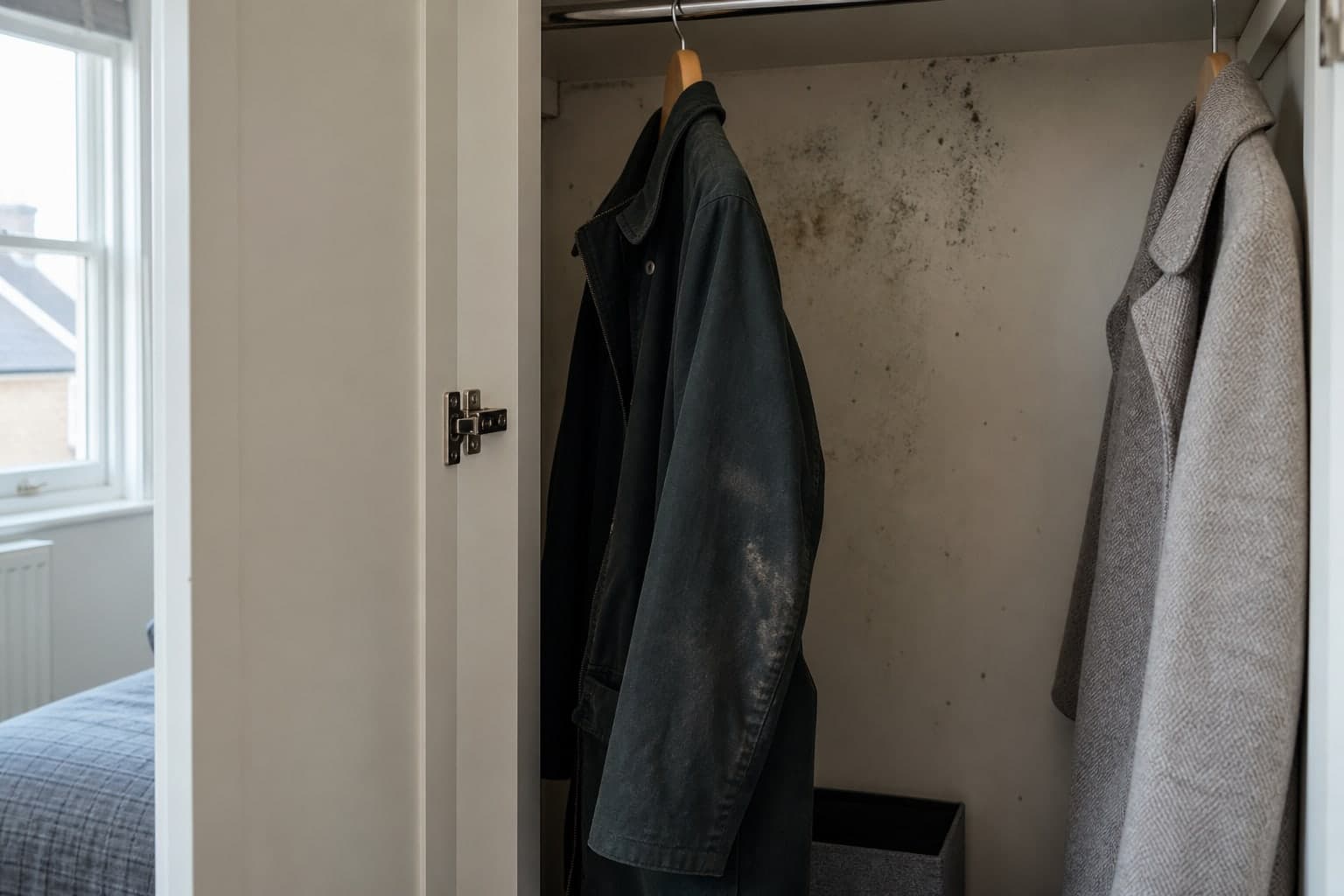
What mould on clothes and inside wardrobes is telling you
Mould growing on clothes, shoes or bags stored inside a wardrobe is a sign that the condensation problem in that room is serious - and it is almost always a building problem rather than a lifestyle one.
Most wardrobes are placed against external walls, which is fine until that wall becomes a cold spot. The wardrobe blocks the wall from the room's warmth. The air inside the wardrobe is cold and still. Moisture from the room seeps in and condenses on the cold back panel and the wall behind it, and then settles on anything stored against it.
The tenant is not generating extra moisture inside the wardrobe - the cold wall is drawing moisture out of the air that finds its way in. The fix is to address the cold wall through improved insulation, or at minimum to create a small gap between the wardrobe and the wall to allow some air movement.
Mould found on clothes in wardrobes across multiple rooms in the same property points to a wider insulation or ventilation deficit that warrants a professional assessment rather than a room-by-room clean.
What the location tells you about responsibility
Once you know where mould is appearing and why, the question of responsibility becomes clearer. Condensation mould driven by structural cold spots, inadequate extraction or heating problems is the landlord's problem to fix - a tenant cannot insulate a solid external wall or replace a broken extractor fan.
Condensation mould that is genuinely driven by tenant behaviour - never opening windows, drying large amounts of washing in a closed room in a property that is adequately insulated and ventilated - sits in a narrower category. Even then, the safer approach is always to investigate the building first rather than assume it is lifestyle. Councils and courts have become sceptical of the lifestyle defence where the property itself has cold walls and no working extraction.
If you are unsure which applies, a moisture survey will tell you. The alternative - assuming lifestyle and doing nothing - carries real legal risk under the Renters' Rights Act 2025 and the fitness for human habitation rules.
What to do once you have read the signs
A few principles that apply wherever the mould is:
- Diagnose first, treat second. Cleaning the surface is pointless while the moisture source is still active. You will be back in the same spot within weeks.
- For bathroom and kitchen ceiling mould: check the extractor fan is present, operational and - critically - that it vents to the outside rather than into the loft. A damp meter on the ceiling will tell you how much moisture is being retained.
- For wall corner and cold spot mould: check wall temperatures. Properties with solid walls, uninsulated floors or missing cavity fill have structural cold bridges that need proper remediation - cavity injection, internal wall insulation or at minimum anti-condensation measures.
- For ceiling patches suggesting a leak: trace from above before treating from below. Treating the ceiling while the water is still coming in makes no difference and can mask the problem long enough for structural damage to develop.
- For wardrobe mould: move the wardrobe away from the wall temporarily and check the wall behind with a damp meter. If it reads high, the wall needs treatment and the insulation needs improving.
- For chronic condensation: positive input ventilation (PIV) units are worth considering for properties with persistent problems despite working extraction. They pressurise the property with filtered air and push damp air out.
We have completed over 8,500 jobs across London and the South of England and deal with mould of every kind - from bathroom condensation to penetrating damp in solid-wall Victorian terraces. Sending a photo on WhatsApp is the fastest way to get an initial read on what you are looking at. Our mould treatment comes with a 12-month guarantee and we are Constructionline Gold accredited, so the work is documented and evidenced for compliance purposes.
If you need a hand, Simpled Services can help. Call us on 020 4571 7367, message us on WhatsApp at the same number (020 4571 7367), or email hello@simpledservices.co.uk and we will take it from there.