
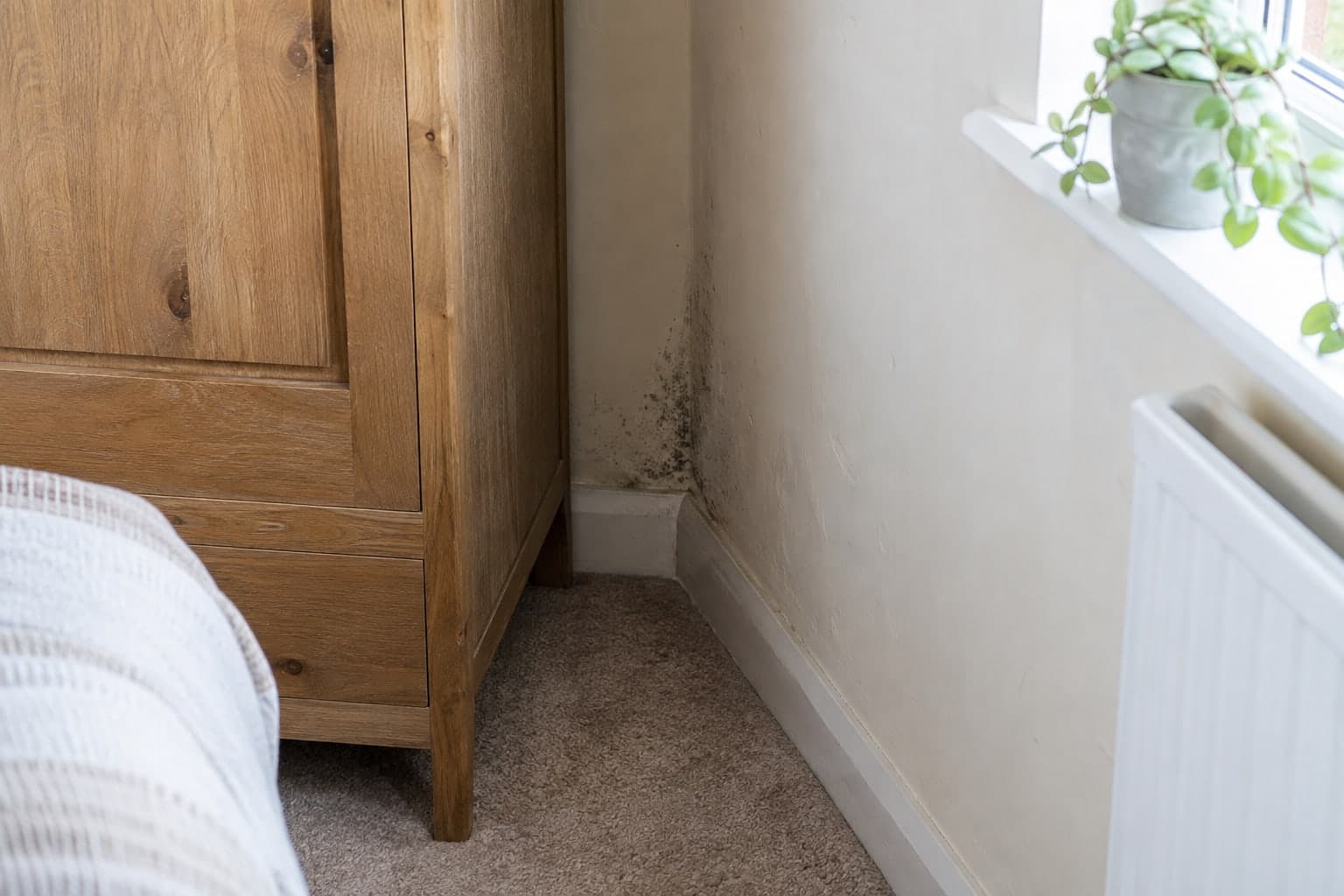
Mould behind furniture and in the corners of rooms is almost always caused by a cold spot - an area of the wall where the surface temperature drops below the dew point, causing moisture in the air to condense. It is one of the most common forms of household mould, and one of the most misunderstood, because it hides out of sight until it has already spread across a wide area.
Unlike mould caused by a leak or rising damp, cold spot mould is driven by physics rather than a plumbing fault. But that does not make it the tenant's problem. In most cases, the conditions that create cold spots - solid external walls with poor insulation, inadequate heating, corners where two external walls meet - are features of the building itself. The tenant cannot insulate the wall or move the structural corner. If those conditions are making the wall cold enough to breed mould, responsibility sits with the landlord.
This guide explains why mould forms in these hidden spots, what a landlord needs to look for, and how to fix the underlying problem rather than just clean the surface.
What is a cold spot and why does mould grow there?
A cold spot is any area of an internal wall surface that is significantly colder than the room air around it. When warm, moist room air meets a cold surface, it releases moisture as condensation - the same physics behind a cold glass sweating on a warm day. If the surface stays cold and the moisture is not removed, mould follows within days.
Cold spots are not randomly distributed. They concentrate in predictable places: the corners where two external walls meet, the inner face of external solid-brick walls, areas behind curtains that trap cold air against glass, and any section of wall that has no insulation at a junction or structural element.
- Corners of rooms where two external walls meet - the worst thermal bridges in most UK period properties.
- External walls in older solid-brick properties, which have almost no insulation value.
- Areas directly below the eaves or behind a flat roof, where the structure is cold and uninsulated.
- Walls adjacent to unheated spaces - a garage, a storage cupboard, or a stairwell that is not heated.
- Beneath window sills and behind curtains that hang low enough to trap cold air near the floor.
Why furniture makes the mould problem worse
Wardrobes, chests of drawers and sofas pushed flush against an external wall do not cause cold spots, but they make the conditions for mould far worse. When furniture sits tight against a wall, it cuts off the circulation of warm room air behind it. That pocket of trapped air loses its heat to the cold wall and stagnates. The wall surface temperature drops further - below what it would be in an open room - and stays there for longer.
The result is that condensation forms on the wall in a zone where it cannot evaporate, and on the back surface of the furniture itself. Mould takes hold quickly in that still, damp microclimate. By the time a landlord or tenant notices - usually when moving the furniture - a significant area of wall is already affected, and the furniture back panel or wardrobe interior is often damaged beyond cleaning.
- A wardrobe pushed against an external wall reduces air contact with that wall to almost zero.
- Still air in the gap cools to near wall temperature, raising relative humidity to near 100%.
- Mould grows on both the wall and the back panel of the furniture.
- Because the affected area is hidden, it often goes untreated for months or years.
- The furniture itself can be ruined by the time the problem is discovered.
Why corners of rooms are always high-risk
A corner where two external walls meet is the hardest thermal problem in a typical UK property. Both walls are losing heat to the outside, and at the junction the geometry concentrates the thermal loss - the wall is effectively being chilled from two directions at once. In an older solid-brick property with no cavity and no internal insulation, the corner surface temperature can sit several degrees below the rest of the room even when the heating is running.
Air does not circulate freely in corners under normal conditions either. Place a tall wardrobe across a cold corner and you have close to zero air movement, a permanently cold surface and no way for any condensation to evaporate. Mould in this situation is not a matter of if, but when.
Is cold spot mould the landlord's responsibility?
Yes, in most cases. Cold spots are a property condition issue, not a lifestyle one. The tenant can open windows and run the heating, but they cannot insulate a solid brick wall, close a thermal bridge at a structural corner, or install a ventilation system. If the building is creating a surface cold enough to condense moisture at normal indoor humidity levels, that is a defect in the property - not a consequence of how the tenant is living.
Councils and courts have become increasingly firm on this point. The Housing Health and Safety Rating System (HHSRS) includes damp and mould as a Category 1 hazard, and the 'it's the tenant's lifestyle' defence has less force when the affected areas are predictably the coldest spots in the building. Landlords who inspect a mould problem and issue lifestyle advice without checking or improving insulation and ventilation are taking a risk.
The tenant can help by keeping furniture away from walls and ventilating regularly - and it is reasonable to point that out as good practice - but you cannot place the entire burden on them when the property itself is the root cause.
How to fix cold spot mould properly
Treating cold spot mould starts with a proper inspection to understand which surfaces are cold and why. A thermal imaging camera or even a simple digital thermometer will show where the cold spots are. Once you know the cause, the fix follows.
- Internal wall insulation - lining cold external walls with insulated plasterboard raises the internal surface temperature and eliminates the cold spot. This is the most effective long-term fix for solid-brick walls.
- Ensuring adequate heating - rooms must reach and hold a temperature that keeps wall surfaces above the dew point. A corner radiator or a small panel heater placed in a cold corner can make a significant difference.
- Continuous background ventilation - a positive input ventilation (PIV) unit or whole-house mechanical ventilation pushes dry air through the property and keeps humidity low, reducing the amount of moisture available to condense.
- Trickle vents in window frames - replacing sealed frames with units that have open trickle vents allows a constant low-level exchange of air without requiring the tenant to open windows.
- Proper mould treatment before reinstatement - the mould needs to be killed and the affected area treated properly rather than wiped down. Any contaminated plaster that has been penetrated will need to be replaced.
- Moving furniture 5-10cm away from external walls - this allows air to circulate and is worth advising tenants to do, but it is a management measure, not a substitute for dealing with the cold spot.
The mistakes that guarantee mould comes back
The most common reason cold spot mould returns is that the surface was cleaned but the underlying wall temperature was never addressed. A bleach spray and a repaint look like a fix for a few weeks, but as soon as the furniture goes back and the season turns cold the condensation starts again. The mould follows within a month.
The second most common mistake is treating it as a tenant education problem. Sending a letter about ventilation and calling it resolved does not change the surface temperature of the wall. If the building is creating the cold spot, tenant behaviour change alone will not prevent mould from returning.
The third mistake is waiting. Cold spot mould behind a wardrobe causes no visible alarm until it is substantial - often affecting a large area of wall and the structure of the furniture. By that point the cost of remediation is far higher than it would have been had the inspection caught it early.
We treat cold spot mould across London and the South of England, working with private landlords, letting agents and housing associations. Every job includes identifying the cause - not just the surface mould - and our work comes with a 12-month guarantee. If the mould comes back within a year, we return at no extra charge.
If you need a hand, Simpled Services can help. Call us on 020 4571 7367, message us on WhatsApp at 07577 772425, or email hello@simpledservices.co.uk and we will take it from there.