
For a small patch of condensation mould on a bathroom tile - one that has never appeared before and where the cause is clearly inadequate ventilation - a surface clean with a proper biocidal wash can do the job. That is the honest starting point: the debate around professional mould removal vs DIY is not a binary choice, it depends entirely on what you are dealing with.
For landlords and property managers, though, the calculation is different from a homeowner cleaning their own bathroom. Recurring mould, mould that follows a tenant complaint, or mould where the underlying cause has not been established are all situations where DIY treatment creates more risk than it removes.
This guide covers what DIY treatment can and cannot achieve, what professional mould removal actually involves, and how to work out which approach your situation calls for.
What DIY mould treatment can handle
DIY is a reasonable starting point in a specific and limited set of circumstances. Used outside those circumstances, it tends to make things worse rather than better - not because of anything complicated, but because it treats the visible surface and leaves the cause alone.
- Small, isolated patches of condensation mould under roughly one square metre on a hard, non-porous surface such as tiles, painted sealant or a coated ceiling.
- Mould where the underlying cause - typically inadequate ventilation - is already understood and is being fixed at the same time as the surface is being treated.
- First occurrences in a property with no previous history of damp, recurring mould or structural moisture issues.
- Situations where the mould has not penetrated into plaster, plasterboard, grout lines, timber or other porous materials.
If you are treating the surface, use a dedicated biocidal spray or wash rather than neat bleach. Look for EN 1276 or EN 13697 on the label - these indicate a product tested to kill mould at the concentration stated. Apply, allow to dwell for the time shown, wipe off and ventilate. Bleach discolours the visible mould growth but does not kill the root structure in porous surfaces, which is why it always comes back.
Where DIY mould treatment falls short
For anything beyond surface condensation mould on a hard finish, DIY cleaning is unlikely to last - and can actively make things worse. The problems are practical, not just about product strength.
- It treats the surface, not the cause. If moisture is working through the wall from outside, rising from below, or condensing because the extractor fan is blocked or venting into the loft, cleaning the visible mould while that moisture source is still active means it comes back - usually within weeks.
- Standard sprays do not penetrate porous materials. Mould that has colonised plaster, rendered surfaces, plasterboard or timber needs specialist biocidal treatment designed to kill the colony through the full depth of the material. Consumer products are not formulated for this.
- DIY cleaning can spread spores. Disturbing mould colonies without containment carries spores into the air and onto other surfaces. In a property where mould is established in more than one room, this can make a manageable problem significantly worse before it gets better.
- There is no documentation. For landlords, documentation matters more than the cleaning itself. A professional treatment produces written moisture readings before and after, a record of work carried out and a report suitable for a compliance file. DIY cleaning leaves no audit trail.
- It will not satisfy an enforcement officer or a court. If a tenant reports mould to the council and an environmental health officer visits, the response 'we cleaned it ourselves' does not close the matter. A professional inspection report and treatment record will.
What professional mould removal actually involves
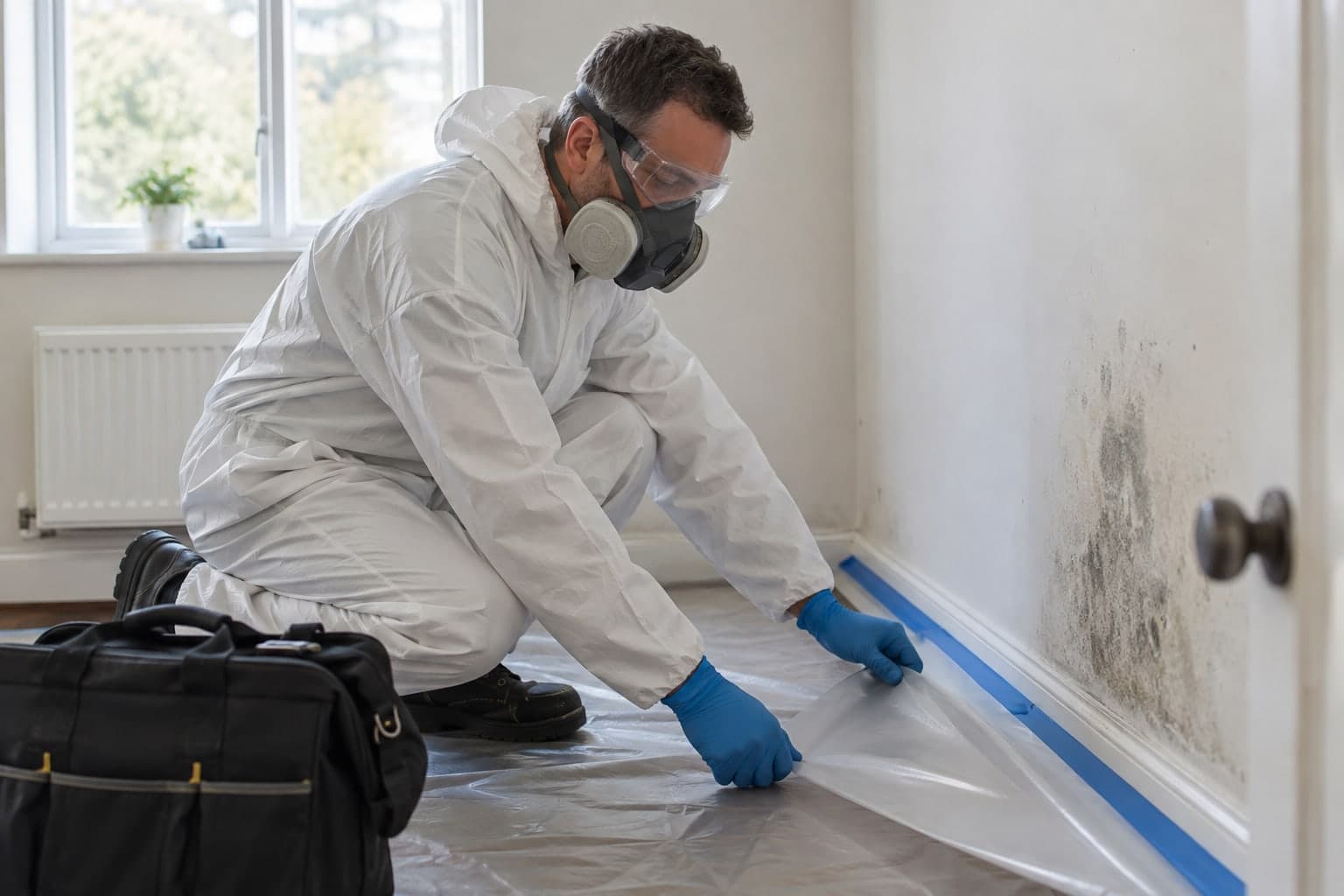
Professional mould removal is not an intensive clean. It is a structured process that begins with diagnosis and ends with documentation. Here is what it involves when done properly.
- Inspection and moisture assessment before any treatment begins. This means checking wall moisture readings, assessing extraction, looking for leaks and identifying any structural damp. Without this step, treatment is guesswork.
- Containment where the scale or location of the mould means that disturbing it without isolation would spread spores to other areas of the property.
- Specialist biocidal application using professional-grade products applied at concentrations and dwell times that kill the colony through the full depth of the affected material - not just the visible surface growth.
- Surface preparation and reinstatement. Where mould has penetrated plaster or finish coats, the affected area is stripped, treated substrate-deep, and replastered or redecorated to a sound finish.
- A written report and guarantee. The job is not complete when the team leaves. You receive documented moisture readings, a record of work done and a guarantee against recurrence within the covered period.
We have completed over 8,500 jobs across London and the South of England and deal with mould across the full range - from bathroom condensation to severe penetrating damp in solid-wall Victorian terraces. Our mould treatment comes with a 12-month guarantee, and we are Constructionline Gold accredited, so the work is properly documented for compliance purposes. Sending a photo on WhatsApp is the fastest way to get an initial read on what you are looking at before booking.
When you should always use a professional
Some situations call for professional treatment regardless of how large the visible mould patch appears to be.
- The mould has returned within weeks or months of a previous clean. Recurring mould is always a sign that the moisture source has not been addressed. A professional will find it.
- The mould covers a large area. HSE guidance suggests that mould covering more than roughly one square metre should be handled by a professional. Beyond that threshold, the risk of spreading spores without proper containment is significant.
- The cause may be structural damp. If there is any possibility that moisture is entering from outside - through failed brickwork, a defective damp course, a roof or gutter problem, or a slow leak - professional assessment is needed before any surface treatment begins. Cleaning over active structural moisture achieves nothing and delays the real fix.
- A tenant has complained in writing. Once a complaint is on the record, your response is too. A professional inspection report and documented treatment is the appropriate response; a DIY spray is not.
- The property is in the social or affordable housing sector. Awaab's Law, which came into force for registered social landlords on 27 October 2025 and expands to cover a wider range of hazards on 30 November 2026, requires damp and mould hazards to be investigated and fixed within strict timescales. Documented professional treatment is the standard that will be expected. The extension to the private rented sector is enabled by the Renters' Rights Act 2025, though a commencement date has not yet been confirmed.
This is general guidance, not legal advice. For advice on your specific situation or obligations as a landlord, speak to a solicitor or your local authority.
A note on anti-mould paint
Anti-mould paint comes up frequently in the same conversation as professional treatment. Several mainstream manufacturers sell paints with fungicidal additives, and they are often positioned as a standalone fix rather than a finishing step.
Used correctly - applied to a thoroughly treated and dried surface over a professionally prepared substrate - anti-mould paint can help extend the time before mould reappears. Used as a cover for active mould or an unresolved damp problem, it performs no better than standard paint. The mould grows through it within months because the moisture causing it is still present.
The correct sequence is: identify and fix the moisture source, treat the mould colony professionally, allow surfaces to dry fully, then redecorate with an appropriate finish. The paint is the last step, not the solution.
How to decide which approach is right
A straightforward decision framework for landlords and agents:
- Small patch, hard surface, condensation cause understood, first occurrence - a biocidal spray is a reasonable starting point.
- Returning mould, porous surfaces, large area or unknown cause - call in a professional.
- Tenant complaint in writing, disrepair letter or council involvement - professional treatment and a documented response, every time.
- Social housing or any property where Awaab's Law applies - professional treatment with a written report is required.
The cost difference between DIY and professional treatment looks significant when you compare product prices, but the real comparison is between professional treatment now and the combined cost of recurring mould, a disrepair claim or council enforcement action later. On that basis, professional treatment is the cheaper option in most cases.
If you need a hand, Simpled Services can help. Call us on 020 4571 7367, message us on WhatsApp at the same number (020 4571 7367), or email hello@simpledservices.co.uk and we will take it from there.