
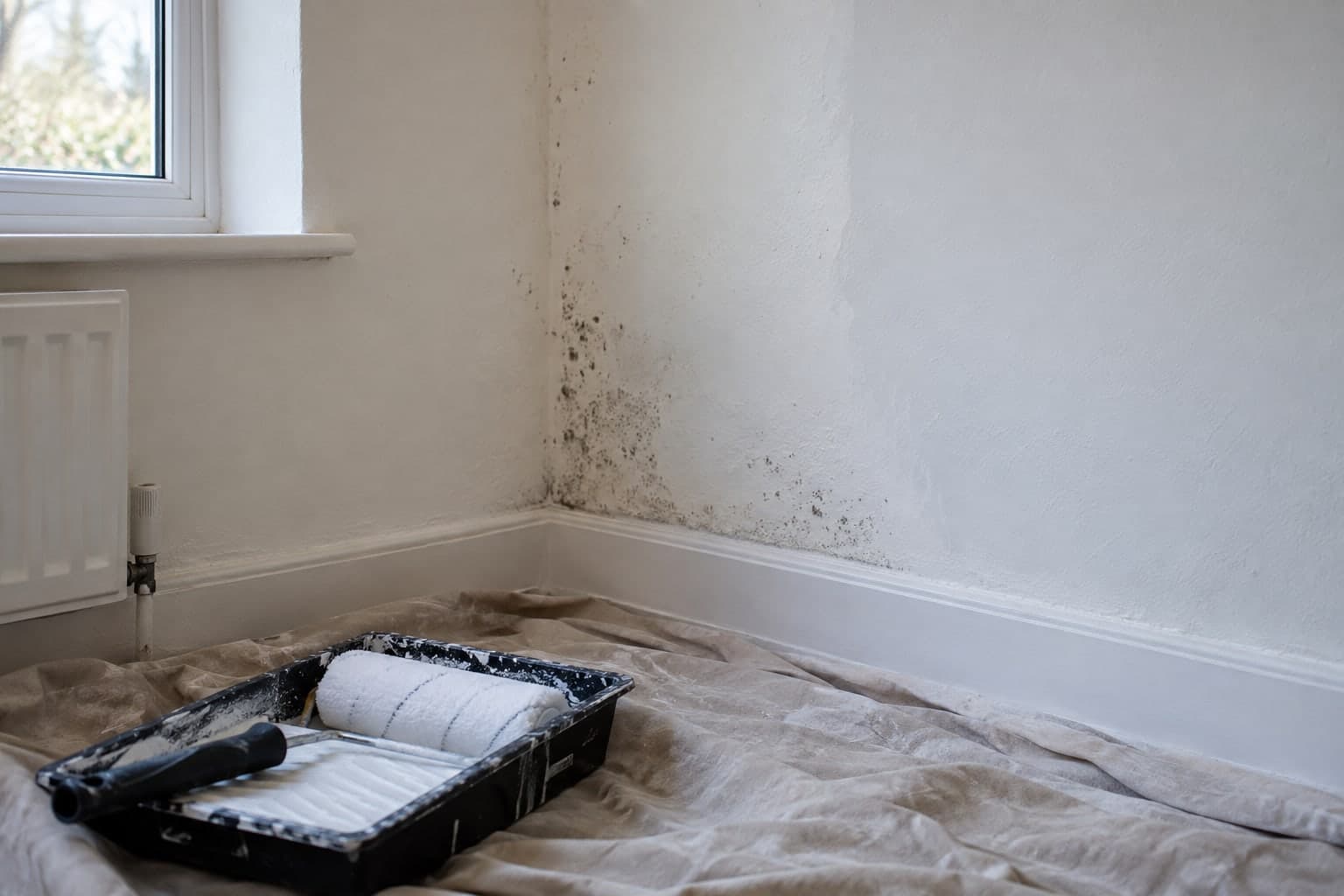
No - you cannot paint over mould and expect it to stay gone. Mould is a living organism rooted into the surface beneath it. A layer of paint does not kill it. It seals in moisture, gives the mould something to feed on, and the growth breaks back through the new surface within weeks. Whether you use standard emulsion, anti-mould paint, or bleach first, the result is the same if the underlying cause has not been fixed: the mould returns, often faster than before.
This is one of the most common mistakes landlords, agents, and tenants make - usually because it looks like a quick fix between tenancies or ahead of a check-out. It is not. A property that has had mould painted over rather than treated properly will fail a future inspection, generate a disrepair complaint, and cost considerably more to deal with by the time the problem is visible again. This guide explains why painting fails, what actually works, and the correct sequence to follow.
Why painting over mould does not work
Mould grows in and through porous surfaces - plaster, plasterboard, timber, grout. By the time it is visible on the surface, the root structure (mycelium) has already penetrated the material underneath. Paint sits on top of the surface. It does not reach the living organism inside the wall.
When you paint over mould without treating it first, several things happen. The paint layer traps moisture against the mould, keeping the conditions it needs to survive. The surface temperature and humidity differential that caused the mould in the first place remains unchanged. Within days to weeks, depending on how much moisture is present, the mould works its way back through the new paint layer - often as dark speckling across what looks like a freshly decorated wall.
Contractors who inherit a property with obvious repeated painting over mould can usually spot the signs: layers of paint built up unevenly, dark shadows visible under the top coat, soft or powdery areas of plaster, and a smell that persists even after decoration. That repeat cycle has its own causes, which we cover in why mould keeps coming back.
What about anti-mould paint?
Anti-mould paints and mould-resistant primers contain biocide additives - fungicidal compounds that inhibit mould growth on the paint surface. They have a role to play, but it is a preventive one, not a remedial one.
Anti-mould paint applied over an existing mould problem does not kill the mould underneath. The biocide in the paint is in the paint film itself, not in any layer it is applied over. The mould beneath is unaffected. The paint may slow regrowth at the surface very slightly, but the underlying infestation continues and breaks through regardless.
Used correctly - on a surface that has been properly treated and dried, in a room where the source of moisture has been fixed - anti-mould paint is a sensible finishing step. It is not a substitute for treatment. Think of it as a finishing coat, not a solution.
Can you paint over mould stains?
Yes, but only once the mould itself has been killed and the surface is dry, and only over a stain-blocking primer. A mould stain is the pigment left behind in the surface after the growth has gone. Standard emulsion does not cover it. The discolouration bleeds back through the fresh coat within days, which is why a wall can look patchy again almost immediately after being decorated.
The reason is that the staining sits inside the surface rather than on top of it. Water-based emulsion goes on wet, softens the stain and draws it up into the new film as the paint dries. A stain-blocking primer seals the discolouration underneath so the top coat has nothing to pull through. It is a cheap step that saves painting the same wall three times.
One thing worth knowing before reaching for the primer: if a stain keeps returning through a properly applied stain block, the problem is not the paint. It usually means the surface is still carrying moisture, or the mould was never fully killed and is quietly regrowing. At that point the right move is to stop decorating and go back to the cause - and telling condensation, damp and a leak apart is where that diagnosis starts.
Can you paint over mould on wallpaper?
No. Mould on wallpaper cannot be treated through the paper and it should never be painted over. Wallpaper and the paste behind it are both organic material that mould feeds on, so the growth is almost always more established behind the paper than the visible patch on the front suggests.
The wallpaper has to come off. Strip it back to the plaster across the whole affected wall rather than just the marked section, because the spread behind the covering rarely matches what is showing through. Treat the exposed plaster with a fungicidal biocide, let it dry fully, then re-line or re-paper. Lifting seams, bubbling, and paper that feels cool or slightly damp to the touch all indicate moisture sitting behind the covering, even where nothing has come through to the surface yet.
Papering straight over mould is the same mistake as painting over it, and it is the one we see most often in properties being turned around at speed - which is precisely when dealing with mould properly between tenancies is worth the extra few days.
Can you paint over a mouldy ceiling?
Not before establishing why the ceiling is mouldy. Ceilings have two very different causes that need opposite fixes, and painting first destroys the evidence that tells you which one you are dealing with.
Condensation mould on a ceiling usually appears in a top-floor room under an unheated loft, and it follows the cold spots. If the speckling maps out in stripes across the ceiling, that is thermal bridging: the joists are colder than the insulated bays between them, so the mould grows along the timber lines and effectively draws you a plan of the roof structure. Concentration in the corners and around the perimeter points the same way, to insulation that stops short of the eaves or has been compressed. The fix there is warmth, ventilation and insulation, and the pattern is one of the clearest ways of telling black mould and condensation mould apart.
A leak-driven ceiling looks different: a defined patch, often ring-shaped with a tide mark at its edge, and frequently under a bathroom or against a roof line. That is a repair job before it is a decorating job. Painting over an active leak means doing the ceiling twice, and where water has been tracking through the structure for a while it usually means replacing the plasterboard as well.
Bathroom ceilings sit in their own category, because the moisture load there is constant rather than seasonal. We cover treating bathroom ceilings and silicone separately.
What actually needs to happen before you paint
Dealing with mould properly before redecoration takes more steps than a single coat, but they are straightforward and the result stays put. The sequence matters.
Step 1 - fix the moisture source
Mould needs moisture to survive. If the moisture source is not removed first, nothing else works for long. The most common sources in rental properties are condensation from inadequate ventilation, penetrating damp through external walls or roofs, rising damp, and plumbing leaks behind walls or under floors, and telling condensation, damp and a leak apart is most of the diagnosis.
Identifying the true source takes a proper investigation - not a glance at the surface. A damp meter reading, checking extractor fans, inspecting the roof and guttering, and looking at where the mould is concentrated in the room all help point to the cause. Treating before this step is done is working backwards.
Step 2 - treat the mould with a proper biocide
Once the moisture source is under control, the existing mould growth needs to be killed using a suitable fungicidal treatment - not household bleach, which is mostly water, dilutes quickly, and does not penetrate porous surfaces effectively.
A professional-grade biocide is applied to the affected area and left to dwell, killing the mould including its root structure within the surface. In severe cases, particularly on plasterboard, the affected material may need to be cut out and replaced rather than treated in place - the mould can be too deeply embedded for surface treatment alone to be effective.
Step 3 - dry the surface thoroughly
After treatment, the surface and the substrate beneath it need to dry fully before any paint goes on. Painting over a damp surface - even one that has been treated - traps residual moisture and creates the conditions for a new problem. Drying time depends on the severity of the moisture ingress and the ventilation in the room, but it is rarely less than a few days and can be weeks for a property that has had serious penetrating damp.
Using a dehumidifier and good ventilation to draw moisture out of the structure speeds the process. A professional contractor uses a damp meter to confirm the substrate has reached an acceptable moisture content before the room is decorated.
Step 4 - apply a stain-blocking primer
Even after correct treatment and drying, mould staining can bleed through standard emulsion. A stain-blocking primer or a dedicated mould-treatment paint system applied as a base coat stops discolouration reappearing through the finished surface.
Step 5 - finish with anti-mould paint in wet rooms
In bathrooms, kitchens, and other rooms with consistently higher humidity, finishing with an anti-mould paint makes sense as an extra preventive layer, alongside the ventilation the room actually needs. In well-ventilated dry rooms it is less critical, but it does no harm. It is the last step in the sequence, not the first.
The cost of getting it wrong
The most common scenario we encounter is a property where mould has been painted over two or three times without the cause being addressed. By the time a landlord contacts us, the wall has a significant mould infestation that has spread well beyond the painted area, the plasterboard or plaster is affected throughout, and what could have been a straightforward treatment job now requires full cut-out and replastering.
The cost difference between treating mould properly the first time and dealing with a wall that has been painted over repeatedly is substantial. Add the risk of a disrepair complaint or a council improvement notice if a tenant reports it, and the case for doing it right first time is clear.
We carry out over 8,500 mould treatment and property maintenance jobs across London and the South of England, working with housing associations, councils, letting agents and private landlords. Our mould removal service treats the source, removes the existing growth with professional-grade biocide, dries the surface and backs the work with a 12-month guarantee - so if it returns, we return to fix it. A professional mould removal job done properly is the only reliable way to stop the cycle of it coming back.
This is general guidance, not legal advice.
If you need a hand, Simpled Services can help. Call us on 020 4571 7367, message us on WhatsApp at 07577 772425, or email hello@simpledservices.co.uk and we will take it from there.