
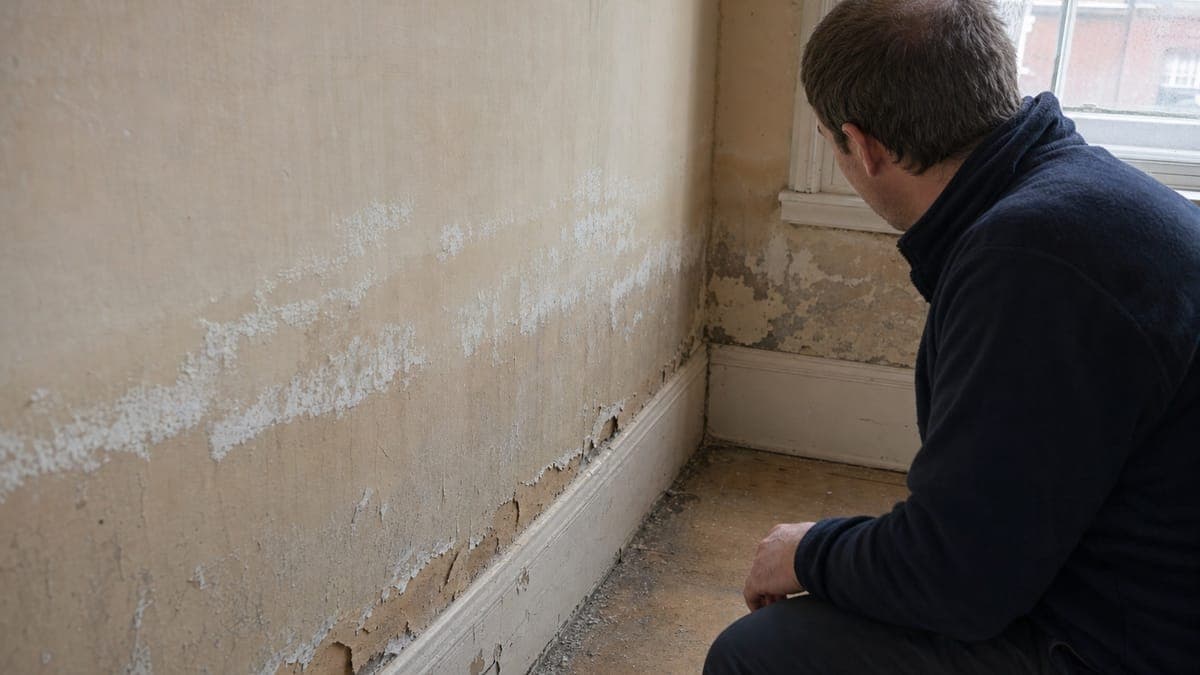
Rising damp has a distinctive look that sets it apart from other moisture problems in rental properties. The clearest signs are a horizontal tide mark or strandline on the lower section of an internal wall - typically below one metre - white powdery deposits on the plaster or brick, and paint or wallpaper that is peeling upward from the floor. If you see those signs together on an external or party wall, rising damp is the most likely explanation.
Many landlords first notice the problem when redecorating: fresh paint starts to peel from the bottom up within months, or new wallpaper lifts at the base and feels damp to the touch. Others notice a persistent musty smell at ground level that does not clear with airing. Unlike condensation mould, which appears at various heights and on the coldest surfaces in a room, rising damp is almost always confined to the lower part of walls, and it looks the same in July as it does in January.
This guide covers the visual signs in detail, explains why each one occurs, helps you distinguish rising damp from penetrating damp and condensation, and sets out what landlords should do when they find it.
The tide mark: the most reliable visual clue
The tide mark - a roughly horizontal band of staining or discolouration across the lower section of a wall - is the single most diagnostic feature of rising damp. It forms because moisture travelling up through the masonry eventually meets enough resistance, from gravity and evaporation, that it can rise no further. At that point, any minerals and salts carried up from the ground are deposited in the wall as the water evaporates, leaving a visible line.
The tide mark is typically between 300mm and 1,000mm above floor level - roughly knee height to hip height. It is usually most pronounced on external walls and on walls that are in contact with the ground. The exact height depends on the porosity of the masonry, the amount of moisture in the ground, and how long the problem has been running.
If a damp stain is appearing above one metre, or on an upper floor, it is very unlikely to be rising damp. Penetrating damp from a defect in the building fabric, or a leak from above, is the more probable cause in those cases - see our guide on rising damp vs penetrating damp for the full comparison.
White powdery deposits (efflorescence)
The white or greyish powdery crust you often see alongside or just above a tide mark is efflorescence - soluble salts drawn out of the ground with the rising moisture and deposited on the wall surface as the water evaporates. This salt staining is one of the clearest indicators that you are dealing with ground moisture rather than a water leak or condensation: neither of those sources carries the same mineral load.
On painted surfaces, efflorescence often appears as a raised, crusty bloom under the paint film - the paint can lift and blister around it. On unplastered brick or blockwork, the salts show as a white powder or crystalline crust. If you wipe it away, it typically returns within weeks as long as the moisture source is active.
A specialist carrying out a moisture survey will often collect a sample of the salts for analysis. Nitrates and chlorides - typical of ground salts - confirm rising damp. The absence of these salts points toward a different moisture source.
Damaged plaster, peeling paint and lifting wallpaper
Plaster affected by rising damp tends to sound hollow when tapped - the bond between the plaster and the wall substrate breaks down as moisture and salts accumulate behind it. Pressing the wall surface near the tide mark often reveals a soft, powdery feel rather than the hard, solid surface of sound plaster.
Paint on an affected wall peels from the bottom upward - sometimes in a clear band from floor to tide mark, sometimes in irregular patches. Wallpaper lifts at the base, feels damp to the touch, and may develop mould on the reverse side where it is in contact with the wall.
The plaster itself may crumble or break away when touched, particularly at the very base of the wall. In severe or long-standing cases, the skirting board rots and timber floor joists near the affected wall can be damaged too.
How rising damp affects floors
In properties with suspended timber floors, rising damp can cause floor boards to feel springy, damp, or uneven near external walls. The timbers beneath - joists, plates, and blocking - are exposed to ground moisture and will begin to rot if the problem runs for long enough. Rot in the floor structure is a more serious consequence than damp plaster, because it affects structural elements that are harder and more expensive to replace.
Solid concrete floors in ground-floor rooms can feel persistently cold and damp, and floor coverings laid directly on them - vinyl, carpet, or laminate - may lift at the edges, develop mould on the underside, or smell musty. Tiles laid over a damp concrete slab may feel loose or sound hollow when tapped.
The smell of rising damp
A persistent, earthy, musty smell at ground-floor level - particularly noticeable near external walls or in corners - is a common early sign of rising damp. The smell comes from damp masonry itself, from any mould that has developed on the affected surface, and from the breakdown of organic material - timber, wallpaper paste, dust - that the moisture has reached.
The smell is relatively constant year-round, unlike condensation damp, which tends to be worse in winter. If a room smells musty in the warmest and driest months of the year, and particularly if the smell is strongest at floor level, rising damp is worth investigating.
Rising damp vs condensation vs penetrating damp
The three main types of moisture problem in UK rental properties have overlapping symptoms but different patterns. Knowing what to look for avoids costly misdiagnosis.
| Sign | Rising damp | Condensation | Penetrating damp |
|---|---|---|---|
| Height on wall | Below ~1m | Any height - worst on cold surfaces | Any height |
| Salt deposits (efflorescence) | Yes | No | Rare |
| Tide mark | Yes - roughly horizontal | No | Irregular patches |
| Worsens in wet weather | No | No | Yes |
| Worst season | Relatively constant | Autumn and winter | Wet weather spells |
| Typical location | External and party walls at low level | Corners, window reveals, behind furniture | Under defects in the building fabric |
How serious is rising damp?
Rising damp is a structural problem and it does not improve on its own. Left untreated, it causes progressive damage: plaster is destroyed by salt attack, skirting boards rot, floor timbers deteriorate, and the affected wall becomes a persistent source of mould growth. The longer it runs, the more expensive the remediation.
For landlords, the legal dimension matters too. Structural damp is a landlord's responsibility under Section 11 of the Landlord and Tenant Act 1985, which requires the structure and exterior to be kept in repair. Under the Decent Homes Standard framework - now being extended to the private rented sector - a property with active rising damp and the associated mould risk would fail the basic condition requirements. A tenant who raises a complaint about damp sets a clock running on your obligation to investigate and act. This is general guidance, not legal advice.
Caught early, rising damp is a manageable repair. The work typically involves clearing any bridging of the damp proof course on the outside, injecting a chemical DPC into the mortar bed if one is absent or has failed, hacking off salt-contaminated plaster, and replastering with a salt-resistant sand and cement render. The wall then needs time to dry out before redecoration.
What to do when you spot the signs
If you recognise the tide mark, efflorescence, or damaged plaster described above, the next step is a professional moisture survey rather than a cosmetic repair. Painting over rising damp, applying surface waterproofing without treating the cause, or simply re-skimming damaged plaster will fail within months - the salts in the contaminated material will drive recurring damage regardless of any surface treatment.
- Photograph the affected area clearly, noting the height of any tide mark above floor level, any white salt deposits, and the condition of the plaster and skirting board
- Check the outside of the building at the same point on the wall - look for paths, flower beds, render, or debris that may be sitting above the damp proof course and bridging it
- Check that air bricks at ground level are clear and open - blocked air bricks reduce sub-floor ventilation and contribute to damp in suspended timber floors
- Commission a professional moisture survey with a calibrated meter before booking any treatment - this distinguishes rising damp from penetrating damp and condensation and scopes the repair correctly
- If a tenant has raised a complaint in writing, respond in writing and confirm that an investigation is under way - documented action is the defensible position under the Renters' Rights Act 2025 framework
- Follow the professional's specification for remediation fully - partial treatment, such as DPC injection without the replastering, or replastering without treating the DPC, rarely holds
How Simpled Services can help
We carry out damp surveys and rising damp treatment for landlords, letting agents, housing associations, and councils across London and the South of England. With over 8,500 jobs completed, Constructionline Gold accreditation, and a 12-month guarantee on our mould treatment work, we are well placed to assess and fix what we find.
A photo of the affected wall sent on WhatsApp gets you a same-day assessment from our team. We can usually tell from a clear photograph whether the pattern looks like rising damp, penetrating damp, or condensation - and if a site visit is needed, we will say so.
If you need a hand, Simpled Services can help. Call us on 020 4571 7367, message us on WhatsApp at the same number (020 4571 7367), or email hello@simpledservices.co.uk and we will take it from there.