
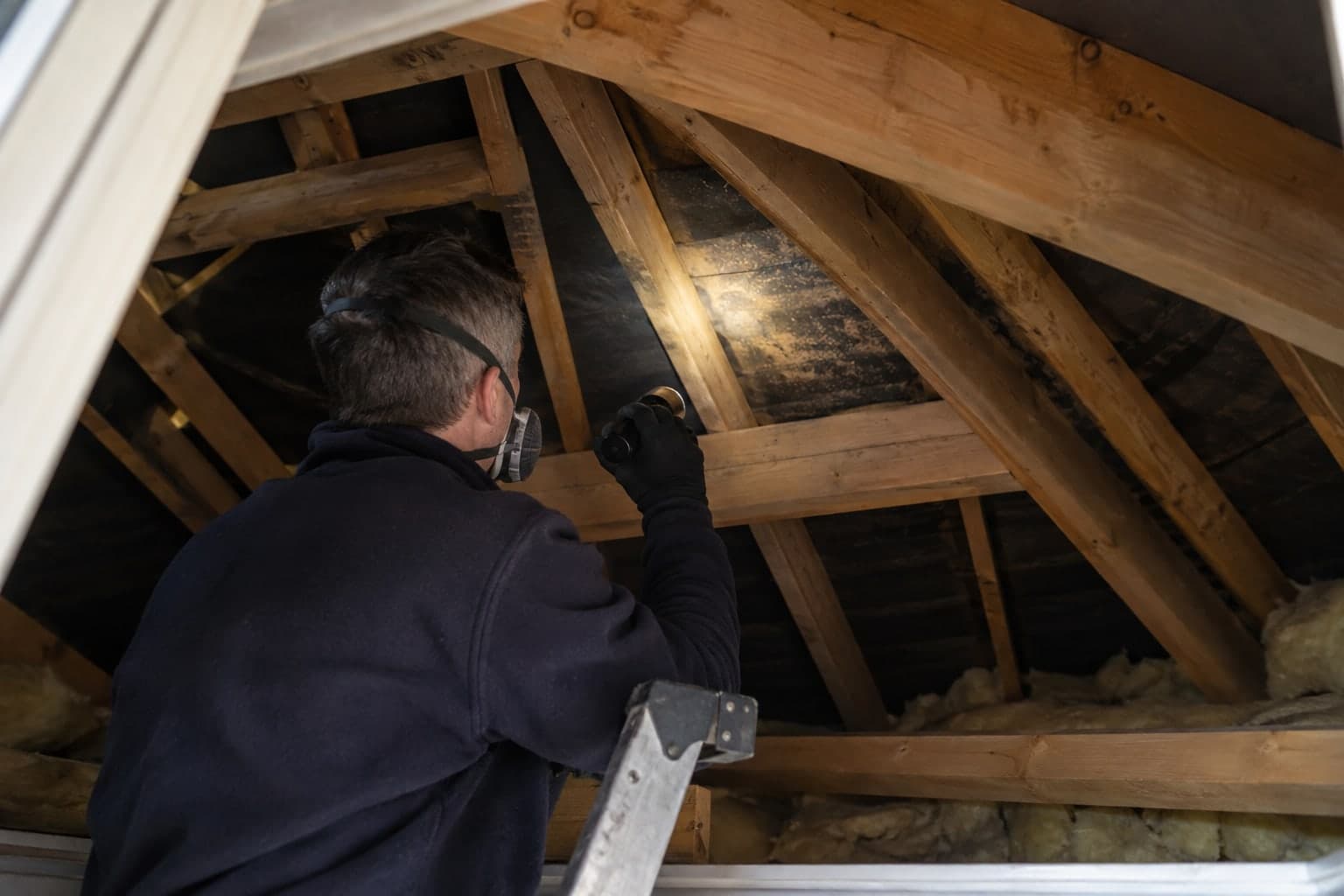
Loft mould causes are almost always one of three things: warm, moist air rising from the living space into the roof void, roof ventilation that is blocked or absent, or a defect in the roof covering that lets water in. In most cases it is a combination of two or all three, which is why a surface treatment on its own never lasts.
What makes loft and roof space mould different from mould in rooms is how long it goes unnoticed. A tenant sees a damp patch on a bedroom ceiling and reports it immediately. The roof void stays out of sight for years. By the time someone opens the hatch and looks, the mould can be widespread across the rafters, sarking board and insulation - and the timber may have started to rot.
This guide explains what drives loft mould, how to identify it before it becomes expensive, and what actually fixes it.
Why loft mould so often goes undetected
Most landlords inspect the rooms, the boiler and the electrics at a property visit. Very few lift the loft hatch and look inside. Tenants rarely go up there either, so mould in the roof void can develop quietly for a season or two before it becomes visible as staining on the ceiling below or as a musty smell in the top-floor rooms.
By the time those signs appear, the mould colony is usually substantial. Timber that has been wet and mouldy for more than a few months starts to soften, and once rot sets in the remediation cost increases significantly. Catching loft mould early is always cheaper than dealing with it after the structure is affected.
The main loft mould causes
Loft mould does not appear from nowhere. Once you identify which of these drivers is present - and often there is more than one - the route to a fix becomes clear.
Condensation rising from the living space
Warm, humid air from the rooms below rises through the ceiling into the loft. If the loft is cooler than the dew point of that air - which it usually is in autumn and winter - the moisture in the air condenses on the cold rafters, felt and sarking boards. This is the single most common cause of loft mould in UK properties, and it is why separating condensation from damp and a leak matters before any work starts.
The condensation risk is made worse when the ceiling has penetrations - recessed light fittings, loft hatches with no draughtproofing, or gaps around pipes - that allow a direct path for humid air rather than just diffusion. Kitchen and bathroom extraction fans that vent into the loft rather than outside compound the problem significantly: they are pushing high-moisture air directly into the space.
- Check loft hatch for draughtproofing - a loose hatch is a major air path.
- Confirm extractor fans from kitchen and bathrooms vent to the outside, not into the void.
- Look for recessed light fittings in the ceiling below - these are rarely airtight.
- Check whether loft insulation covers the eaves and blocks the airflow route (see ventilation below).
Inadequate or blocked roof ventilation
A cold roof (the traditional construction with insulation at ceiling level rather than rafter level) relies on cross-ventilation of the roof void to carry away moisture-laden air. Building regulations have required ventilation at the eaves and ridge for decades, but older properties often have none, and even newer ones can lose it when insulation is installed without maintaining the airflow path.
The most common problems are insulation pushed right to the eaves and blocking the inlet vents, ridge tiles bedded solid with no ventilation gap, or proprietary tile vents that have become blocked with debris. Without air movement, moisture from condensation has nowhere to go and mould follows - the same principle that governs how much ventilation a room needs applies to the roof void.
- Ensure insulation does not block the eaves - there should be a clear 50mm airway above the insulation to the eaves vent.
- Check eaves vents are present and unblocked - lift insulation at the edge to check.
- On older roofs, check ridge tiles: solid-bedded ridge is common and a ventilated ridge is often needed as an upgrade.
- Tile or slate vents can be added to an existing roof if cross-ventilation is missing.
Roof defects that let water in
Penetrating damp from a defective roof is a distinct cause from condensation, though both can be present at once. Slipped or cracked slates, failed lead flashings at abutments and valleys, cracked ridge mortar, or a perished or torn roofing underlay (felt) can all allow rainwater to reach the roof structure.
The clue is timing: if the mould and damp are worse after a period of heavy rain, or if there is a tidal stain pattern on the rafters pointing toward a specific point, a roof defect is almost certainly involved. Condensation, by contrast, is worst in the colder months and tends to be more uniform across the void.
- Inspect the underlay from inside the loft in daylight - pinhole lights show areas where felt has perished.
- Look for tide marks or staining on rafters that track toward one location.
- Check flashings at chimneys, dormer cheeks, valleys and abutments with flat roofs.
- After heavy rain, inspect the ceiling in top-floor rooms for fresh damp spots.
Cold bridging and missing or thin insulation
Where insulation is patchy, thin or missing, the ceiling surface underneath can be cold enough to hit the dew point of the room air below, causing condensation on the ceiling itself rather than in the loft. This looks like mould at the ceiling rose, around the loft hatch frame, or in the corners where the roof slope meets the top-floor ceiling - spots that are structurally cold.
It is a different mechanism from loft condensation but shares the same fix: proper, continuous insulation with no gaps, and a draught-sealed hatch.
How to inspect a loft for mould
A loft inspection takes about 15 minutes and can save thousands. You will need a torch, a dust mask and gloves. Do not walk on the ceiling joists without boards - one slip and a foot goes through the ceiling.
- Look at the underside of the roof deck and rafters for dark staining, white salt crystallisation or furry mould growth.
- Check the underlay for tears, perishing or wet patches.
- Feel the insulation surface - if it is damp or compressed under the eaves, airflow is blocked.
- Look at the loft hatch surround and any pipes or cables passing through the ceiling for gaps.
- Smell: a persistently musty loft smell means mould is present even if you cannot see it clearly.
- Look down at the top of the ceiling insulation for staining or wet patches that indicate penetrating water.
Fixing loft mould properly
Surface treatment alone - spraying the timber with a fungicidal wash and leaving it - will not solve a loft mould problem if the underlying moisture source remains. Within a season the mould returns, which is the usual reason mould keeps coming back after treatment. A lasting fix involves three things working together: removing the existing mould, stopping the moisture source, and improving the conditions so the space stays dry.
- Treat affected timber with a proprietary fungicidal solution and allow full drying time before any works that close the space up.
- Fix any roof defects - replace slipped slates, repoint ridge, reflash or replace the underlay as needed.
- Ensure extractor fans discharge outside - run a new duct to the eaves or through the roof if they currently vent into the void.
- Clear eaves vents and reinstate the 50mm clear airway above the insulation.
- Add ventilation if it is absent - eaves vents, tile vents, a ventilated ridge or a combination.
- Seal the loft hatch and all ceiling penetrations against air movement.
- If the insulation is contaminated, it should be removed, the timber treated, dried and new insulation installed.
When to call a specialist
A small area of surface mould on timber - say a square metre or two of light growth on a single rafter - can be treated as a DIY task by a competent person with the right PPE and a proper fungicidal product. Anything beyond that is a job for a professional: widespread mould across the structural timbers, any sign of rot, mould in the insulation, or mould linked to a roof defect that needs fixing alongside the treatment.
We treat loft mould on behalf of landlords, letting agents, housing associations and councils across London and the South of England. Our process finds the cause, treats the structure properly and backs the work with a 12-month guarantee. It is the same mould removal across London process we run in the rooms below, adapted for an unheated roof void. A photo of the loft hatch area on WhatsApp is often enough for us to give you an initial steer on what you are dealing with.
This is general guidance, not legal or structural advice. If you have concerns about the structural integrity of the roof, instruct a surveyor.
If you need a hand, Simpled Services can help. Call us on 020 4571 7367, message us on WhatsApp at 07577 772425, or email hello@simpledservices.co.uk and we will take it from there.