
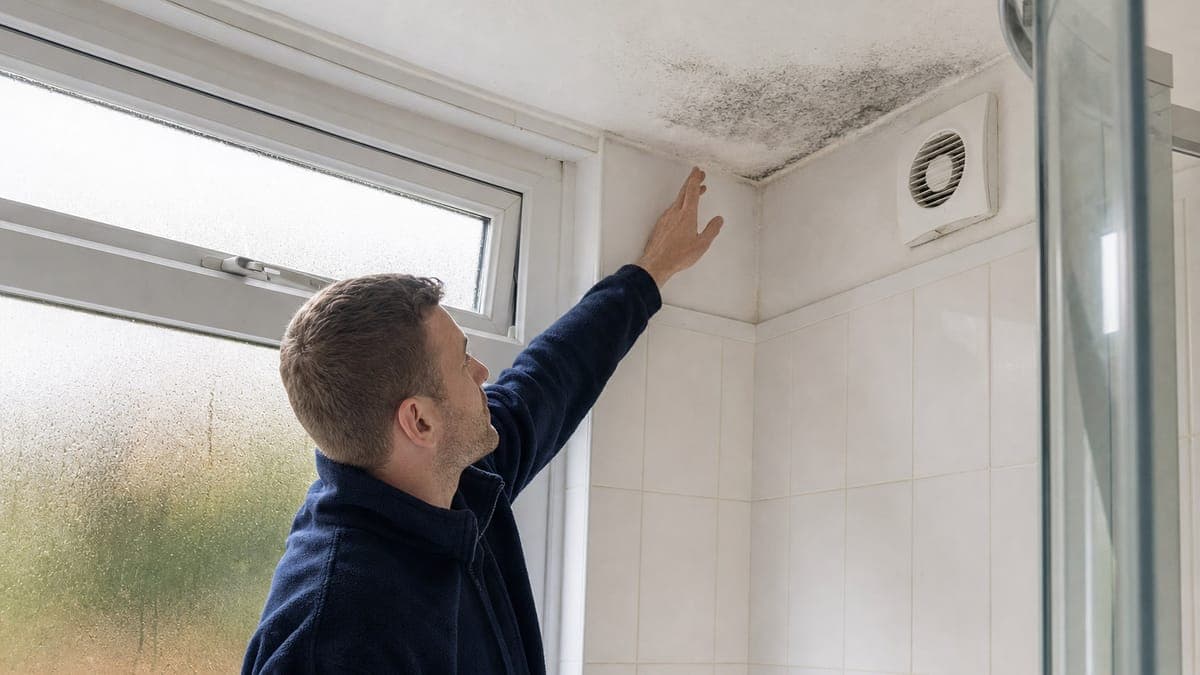
Fixing condensation in a rental property starts with understanding why it forms. Warm, moist air hits a cold surface - a wall, a window, a ceiling corner - and the moisture it carries turns to liquid water. Do that repeatedly in a poorly ventilated or under-heated room and you get wet walls, mould, and eventually damage to plaster and finishes. The fix is to either reduce the moisture in the air, raise the surface temperature so condensation does not form, or extract the moisture before it settles.
Many landlords reach for a dehumidifier or tell the tenant to open more windows. That is sometimes part of the answer, but it rarely fixes the problem on its own. Persistent condensation usually has a structural cause - inadequate ventilation, insufficient heating, or cold bridging - and structural causes are the landlord's responsibility to address. Under the Renters' Rights Act 2025 and the broader Decent Homes Standard framework that is now being extended to private landlords, a property that is habitually damp and conducive to mould growth is one you are legally required to bring up to standard.
This guide explains the real causes of condensation in rental properties, the practical fixes - from extractor fans to insulation - and the legal context landlords need to understand. This is general guidance, not legal advice.
What causes condensation in a rental property
Condensation forms when moisture-laden air meets a surface that is cold enough to drop the air temperature below its dew point - the point at which it can no longer hold the water vapour. In a typical rental property, the main moisture sources are cooking, bathing, laundry, and breathing. In a well-ventilated property with adequate heating, that moisture is carried outside before it condenses. In a poorly ventilated or cold property, it lands on the walls.
The worst spots in a typical rental are bathroom and kitchen ceilings, external wall corners, window reveals, and the areas behind large furniture against cold external walls. These are all places where the surface temperature is lower than the rest of the room - either because the wall itself is cold (poor insulation or a cold bridge in the fabric), because the space is less well-heated, or because warm moist air from cooking or bathing reaches the surface before it can be extracted.
- Poor or absent mechanical ventilation - no extractor fan in bathroom or kitchen, or an extractor that discharges into the roof void rather than outside
- Inadequate heating - rooms that are rarely heated allow surface temperatures to fall well below the dew point
- Cold bridging - areas where the thermal insulation of the wall is interrupted, creating a cold spot that consistently collects condensation
- Single-glazed windows - glass surface temperature drops sharply on cold nights, making window condensation severe
- Lack of trickle ventilation - replacement windows fitted without trickle vents reduce background air change
- Tenant behaviour in combination with any of the above - for example, drying clothes on radiators in a room with no opening window and no extractor
Condensation, damp and mould - knowing the difference
Condensation is one cause of damp, but not the only one. Getting the diagnosis right before spending money on a fix is essential. Condensation mould appears on the coldest surfaces in a room - typically at ceiling height in corners, on window reveals, and on external walls behind furniture. It is usually worst in autumn and winter when external surfaces are coldest and heating patterns change.
Rising damp appears at the base of walls, usually with a horizontal tide mark and white salt deposits - see our guide on what rising damp looks like for the visual detail. Penetrating damp appears irregularly, linked to specific weather events, and is usually associated with a defect in the building fabric such as a failed seal, cracked render, or blocked gutter. If you are not sure which problem you are dealing with, a professional moisture survey will distinguish them quickly.
The landlord's legal responsibility for condensation
Landlords sometimes assume condensation is always a tenant behaviour issue and therefore not their problem. The law does not see it that way. Under Section 11 of the Landlord and Tenant Act 1985, the structure and exterior of the property must be kept in repair - and that includes maintaining adequate ventilation systems. Under the Housing Health and Safety Rating System, severe condensation and mould is assessed as a potential Category 1 hazard, which councils can act on by issuing an improvement notice.
The Renters' Rights Act 2025 abolished Section 21 no-fault evictions and introduced periodic tenancies across the board. It also brought the Decent Homes Standard framework closer to the private rented sector, making it harder for landlords to argue that poor property conditions are a tenant problem rather than a landlord one. Awaab's Law - which sets strict timescales for investigating and fixing damp and mould hazards - applies to social landlords now and is expected to be extended to cover the private rented sector over 2026 and 2027.
In practical terms: if a tenant reports persistent condensation or mould and you do not investigate and address the underlying cause, you are exposed. A tenant can raise a complaint with the new Private Rented Sector Ombudsman, contact the local council for an HHSRS inspection, or pursue a housing disrepair claim. Documented action - responding in writing, commissioning an inspection, and carrying out appropriate works - is what protects you.
Practical fixes for condensation in a rental property
There is no single universal fix. The right approach depends on where the condensation is worst, what is causing it, and what the property's current ventilation and heating systems look like. The following are the most effective interventions.
Improve or install mechanical ventilation
An extractor fan in the bathroom and kitchen is the single highest-impact intervention in most rental properties. If no fan is fitted, install one. If one is already fitted, check it is actually discharging outside - not into the loft - and that it is powerful enough for the room. A bathroom fan rated at 15 litres per second is the Part F minimum for an intermittent fan. Many older installations fall well short of this.
For whole-house condensation problems - especially in well-sealed properties where background ventilation is limited - a Positive Input Ventilation (PIV) unit installed in the loft is effective. These draw fresh, slightly warmed air from the loft space and push it gently through the property, diluting moisture before it can settle. They are relatively inexpensive to install, run quietly, and require minimal maintenance.
- Replace a slow or undersized bathroom extractor with a compliant fan rated at 15 l/s or above
- Ensure kitchen extractors discharge externally - not via a recirculating carbon filter - and have sufficient flow for the room volume
- Fit trickle vents to replacement windows if not already present - check current window specifications
- Consider a Positive Input Ventilation unit for properties with whole-house condensation
Improve heating and insulation
Cold surfaces condense moisture. Raising the surface temperature - by heating the room more consistently, improving insulation, or eliminating cold bridges - reduces condensation directly. A property that is heated only intermittently will always have worse condensation than one kept at a steady background temperature, because the wall surfaces take time to warm up and stay cold for long periods.
Cold bridging - where concrete lintels, solid masonry reveals, or structural ties break the insulation layer - creates consistently cold patches that collect condensation regardless of how warm the room is. A thermal imaging survey identifies these spots clearly. Fixes range from internal insulated dry-lining at the cold bridge to external insulation applied to the wall.
- Check that radiators are appropriately sized for each room - undersized radiators in bedrooms and bathrooms are a common cause of persistent cold spots
- Ensure tenants have access to affordable, functional heating - a broken boiler or an inaccessible timer will cause condensation even in a well-insulated property
- Commission a thermal imaging survey if specific cold spots are causing recurring mould - these identify cold bridges that are not obvious to the eye
- Consider internal insulated dry-lining on particularly cold external walls if condensation is severe and ventilation improvements alone are insufficient
Address the moisture source in bathrooms and kitchens
The most moisture-intensive activities in any home are showering, bathing, and cooking. A bathroom without mechanical extraction or a kitchen without an externally venting hood will generate more moisture than any amount of background ventilation can handle. If the fan in the bathroom runs only while the light is on and switches off immediately when the light goes off, fitting a timer-controlled fan that runs on for 15 minutes after use will make a noticeable difference.
Shower enclosures and bath surrounds should be properly sealed at the grout and silicone joints. A failing silicone seal allows water to track behind tiles and surfaces, adding to the moisture load in the structure even when the bathroom appears dry.
What tenants can do - and where the limits are
Tenants can help by using extractor fans when cooking and bathing, keeping bathroom and kitchen doors closed when generating steam, and airing the property with a brief window opening. These behaviours reduce the moisture load in the property and make the structural fixes more effective.
However, a landlord cannot rely on tenant behaviour to carry the whole responsibility. If the property does not have adequate mechanical ventilation, if the heating system is insufficient or broken, or if the structure has cold bridges that cause predictable condensation, those are structural issues that need structural fixes. Telling a tenant to open more windows is not a repair. If you make an appropriate structural fix and condensation continues because a tenant is, for example, drying multiple loads of laundry on radiators in a sealed room, the position changes - but that requires you to have fixed the structural issues first.
How Simpled Services can help
We diagnose and fix condensation problems for landlords, letting agents, housing associations, and councils across London and the South of England. That means identifying the real cause - ventilation, heating, cold bridges, or a combination - and carrying out the right remedial work rather than a surface fix that will fail within months.
We have completed over 8,500 jobs, hold Constructionline Gold accreditation, are fully insured, and carry a 12-month guarantee on our mould treatment work. A clear photograph of the affected area sent on WhatsApp gets you a same-day assessment from our team.
If you need a hand, Simpled Services can help. Call us on 020 4571 7367, message us on WhatsApp at the same number (020 4571 7367), or email hello@simpledservices.co.uk and we will take it from there.