
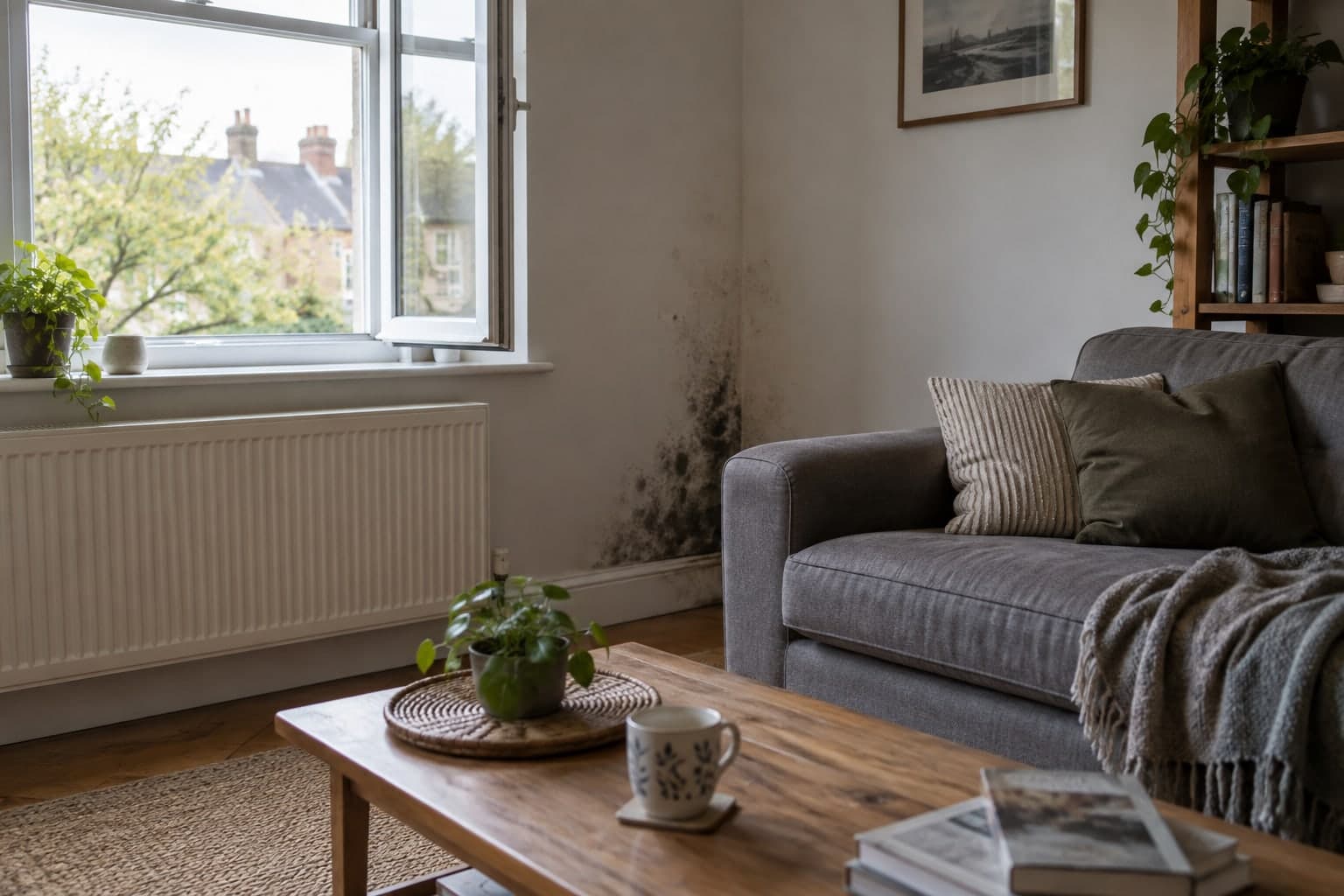
Yes, black mould is dangerous to health. Exposure to black mould - whether the common Cladosporium species or the more toxic Stachybotrys chartarum - releases spores and mycotoxins into the air that can cause respiratory problems, trigger asthma attacks, and in vulnerable people cause serious illness. The UK Health Security Agency (UKHSA) and the NHS both recognise indoor mould as a significant health hazard, and the Housing Health and Safety Rating System (HHSRS) classes heavy mould growth as a Category 1 risk - the same category as carbon monoxide and structural collapse.
How dangerous black mould is depends on a few things: the species, how long the exposure lasts, how much mould is present, and the health of the person living with it. A small patch of surface mould in an otherwise well-ventilated property is not the same as mould covering a bedroom ceiling in a child's room. But even low-level exposure over months or years can add up, and for some people the effects are immediate and severe.
For landlords and property managers, this is not just a health issue - it is a legal one. The tragic death of two-year-old Awaab Ishak, caused by prolonged exposure to black mould in a social rented property, led directly to new legislation that is reshaping how quickly landlords must act. This guide explains the health risks in plain terms and what you are expected to do about it.
What is black mould?
The term 'black mould' is used loosely to describe any dark-coloured mould growth, but there are several different species that appear black or dark green. The most common in UK homes is Cladosporium, which grows readily on cold, damp surfaces and is found on bathroom ceilings, window frames and the backs of wardrobes. Stachybotrys chartarum is less common but more toxic - it grows on materials with a high cellulose content (plasterboard, timber, wallpaper) that have been wet for a prolonged period.
Both types release spores. Stachybotrys also produces mycotoxins - toxic compounds that can cause more serious effects than spore exposure alone. Identifying the exact species requires laboratory testing, so in practice the safe approach is to treat any significant black mould as a potential health risk and deal with it properly rather than waiting for confirmation.
See what causes mould in a house for a full explanation of the conditions that drive mould growth - condensation, damp and poor ventilation are the main culprits in the vast majority of cases.
How does black mould affect health?
Black mould affects health primarily through the respiratory system. When mould spores become airborne - which happens whenever the mould is disturbed, when it dries out, or simply as a result of air movement in the room - they can be inhaled deep into the lungs. The most commonly reported effects are:
- Persistent coughing and wheezing.
- Worsening of asthma - more frequent attacks, greater use of inhalers.
- Allergic rhinitis - runny nose, sneezing, nasal congestion.
- Sinusitis and recurring chest infections.
- Watery, red or itchy eyes.
- Skin rashes or irritation.
- Headaches and fatigue with prolonged exposure.
In most healthy adults, short-term exposure causes irritation rather than lasting harm - though it is unpleasant and disruptive. The concern is sustained exposure over months or years, particularly in a bedroom or living room where someone spends many hours a day. That kind of ongoing exposure can sensitise the immune system and make reactions more severe over time.
Vulnerable groups: who is most at risk?
The health effects of black mould are significantly worse for people who are already vulnerable. The groups most at risk are:
- Infants and young children - their immune systems are still developing and they spend more time indoors.
- Elderly people - more likely to have underlying respiratory or cardiac conditions.
- People with asthma, hay fever or other allergies - mould is a recognised asthma trigger.
- People with weakened immune systems - including those on immunosuppressant medication, undergoing cancer treatment, or living with HIV.
- People with existing lung conditions such as COPD or bronchiectasis.
For these groups, exposure that a healthy adult might tolerate can trigger serious illness. The death of Awaab Ishak in Rochdale in December 2020 - a two-year-old boy who died from a respiratory condition caused by prolonged exposure to black mould in his family's social housing flat - is the starkest illustration of what untreated mould can do to a vulnerable child.
Black mould health issues: what the NHS and government guidance say
If you want the neutral medical position rather than a contractor's, start with the NHS. Its guidance is that people living with damp and mould are more likely to have respiratory problems, respiratory infections, allergies and asthma, that exposure can affect the immune system, and that sore eyes, eczema and fungal skin infections are among the recognised effects. None of that is limited to one species of mould - our guide to the health risks of mould in your home covers the full picture beyond black mould specifically.
A question we hear a lot is whether mould only matters if it is the 'toxic' kind. The government's damp and mould guidance - written by health and housing departments together after the Awaab Ishak inquest - is clear that damp and mould in the home produce allergens, irritants, mould spores and other toxins that are harmful to health, and that dampness alone increases the risk of health problems even where no visible mould is present. It draws no distinction by colour or species, and a landlord's response should not either: waiting for laboratory confirmation of Stachybotrys before treating a mouldy room is a delay, not due diligence.
If anyone in the household has symptoms they think are linked to mould, they should speak to a GP or call 111. Our job is the building - finding the moisture source, treating the mould and stopping it returning.
Black mould in a bedroom: why it is the worst place to have it
The same patch of black mould is more dangerous in a bedroom than anywhere else in the property, for a simple reason: exposure time. Whoever sleeps there spends seven or eight unbroken hours a night in that room, often with the window shut and the door closed, breathing whatever is in the air. Bedrooms are also where the classic conditions line up - overnight breathing raises the humidity, the heating is usually off so surfaces are cold, and black mould appears on the ceiling above the bed, in the corners of external walls and behind wardrobes pushed against cold walls.
A child's bedroom is the highest-risk room in the house. Children have smaller airways and developing immune systems, and they typically spend more hours in their bedroom than any adult spends in any room. If a property you own or manage has black mould in a child's bedroom, treat it as urgent - that is precisely the situation the Awaab Ishak case turned on.
While a proper fix is arranged: air the room every morning, keep furniture pulled slightly off external walls, and do not scrub or dry-brush the mould, which releases spores into the air. Mould on a bedroom ceiling is usually condensation forming on a cold surface rather than a leak - our guides to mould in bedrooms and telling black mould from condensation mould explain how to read the pattern and what actually fixes it.
Awaab's Law: why the law changed
The inquest into Awaab Ishak's death found that his landlord, Rochdale Boroughwide Housing, had repeatedly failed to act on his parents' complaints about the mould in their flat. The coroner's findings prompted the government to act, and Awaab's Law was introduced as part of the Social Housing (Regulation) Act 2023. It places strict timescales on social landlords to investigate and fix damp and mould once a tenant reports it.
As of 2026, these requirements apply to social landlords: emergency hazards and damp and mould are covered now, Phase 2 extends the same fixed timescales to a much wider set of hazards from 30 November 2026, and Phase 3 follows in 2027. For private landlords, the extension of Awaab's Law sits in phase 3 of the Renters' Rights Act implementation roadmap - the government has committed to it, but it is subject to consultation with no commencement date announced, so treat 2027 as the earliest realistic point. The Renters' Rights Act 2025 has still changed the picture for every landlord: Section 21 'no-fault' evictions were abolished on 1 May 2026, so a tenant who reports mould cannot simply be served notice, and a Private Rented Sector Landlord Ombudsman is being set up to give tenants an out-of-court route to force action, with membership expected to become compulsory in 2028.
The direction of travel is clear: landlords who delay acting on mould reports face increasing legal and regulatory exposure. This is general guidance, not legal advice - if you are facing enforcement action or a formal disrepair claim, take proper advice on your specific situation.
HHSRS and the legal classification of mould
Under the Housing Health and Safety Rating System (HHSRS), damp and mould growth is a recognised hazard. When the mould is serious enough to represent a significant risk of harm to the occupants, it is assessed as a Category 1 hazard - the highest category. Local councils can inspect properties for HHSRS hazards and, where they find Category 1 hazards, they have a duty to take action. That can mean an improvement notice requiring the landlord to carry out works within a set period, with financial penalties for failure to comply.
The classification as a Category 1 hazard depends on the severity and the vulnerability of the occupants. A single damp patch on a wall is unlikely to reach that threshold. Extensive mould covering walls and ceilings in a home with children or elderly occupants almost certainly would.
What landlords should do when mould is reported
When a tenant reports mould, the starting point is always to investigate the cause - not just clean the surface. Treating the visible mould without addressing the moisture driving it means it will return, and you will have a paper trail showing you knew about it.
- Respond in writing and acknowledge the report promptly.
- Arrange an inspection as soon as possible - do not let it drift.
- Identify the underlying cause: is it a leak, penetrating damp, rising damp, condensation from poor ventilation, or cold spots in the building fabric?
- Treat the mould properly and fix the root cause in the same visit or shortly after.
- Improve ventilation where the building is the problem - extractor fans, trickle vents, secondary glazing on cold windows.
- Keep full records: dates of the report, inspection findings, works carried out. Good documentation is your best protection if a claim follows.
Painting or bleaching over mould is not fixing it. It hides the problem for a few weeks, then it returns - and the evidence of delay is now in your maintenance records.
For persistent or extensive mould, professional treatment is the only reliable answer. Simpled Services provides specialist mould removal and treatment across London and the South of England, backed by a 12-month guarantee. We have completed 8,500+ jobs for housing associations, councils, letting agents and private landlords and hold Constructionline Gold accreditation. A photo sent on WhatsApp is usually enough to get you a same-day quote. See our guide to getting rid of black mould on walls for the detail on what proper treatment involves.
The health risk is the same wherever it grows, but the housing stock changes what we find: Lewisham's period conversions, for instance, tend to trap moisture in bathrooms without proper extraction.
If you need a hand, Simpled Services can help. Call us on 020 4571 7367, message us on WhatsApp at 07577 772425, or email hello@simpledservices.co.uk and we will take it from there.