
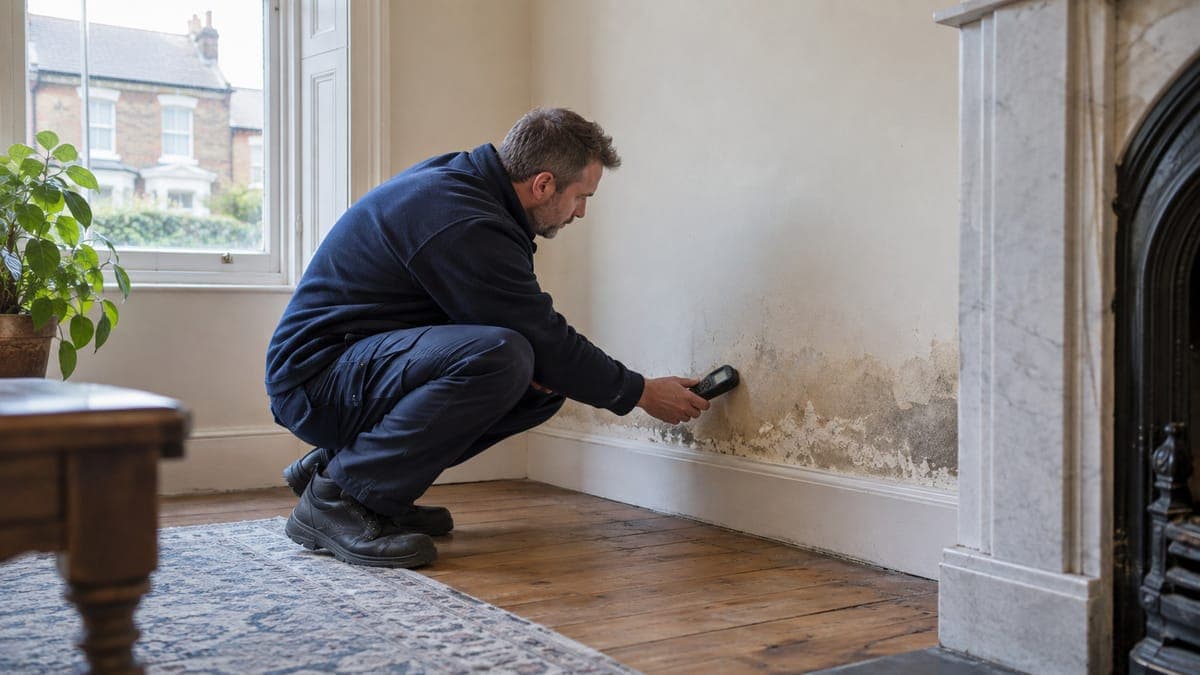
A damp survey is worth commissioning when there are visible signs of moisture problems, when you are buying an older property without a recent building survey, or when a tenant has raised a damp or mould complaint and you cannot identify the cause yourself. In those situations, the cost of a professional inspection - typically a few hundred pounds - is trivial compared to the cost of treating the wrong problem or missing a serious one. In a property that is sound, recently built, and showing no signs of moisture, a damp survey is rarely necessary.
The harder question for most landlords is not whether damp surveys exist but when to use one. This guide answers that directly: the situations where commissioning a survey is the right call, what a surveyor actually looks at, what the report tells you, and what to do once you have the findings.
This is practical guidance for landlords, letting agents, and property managers. It is not legal advice - for specific disputes or enforcement matters, seek specialist legal guidance.
What is a damp survey?
A damp survey is a professional inspection of a property to identify the source, type, and extent of any moisture problems. A specialist uses a calibrated moisture meter to take readings in walls, floors, and ceilings across the property, comparing affected areas with dry reference points. The aim is to distinguish between the three main types of moisture problem - rising damp, penetrating damp, and condensation - because each has a different cause and a different fix.
A proper damp survey is not a visual inspection or a quick scan with a cheap meter. It involves taking readings at multiple heights on suspect walls, checking the salt content of plaster (to confirm rising damp rather than another moisture source), examining external building fabric for defects, checking roof and gutter condition, and reviewing ventilation. The surveyor should produce a written report that identifies the problem type, its likely source, and a clear remediation recommendation.
Independent damp surveys - carried out by a surveyor with no financial interest in the remediation work - give a more reliable diagnosis than surveys offered free by treatment companies. A survey company that also sells damp treatment has an incentive to find problems that require their services. If you are spending money on a survey, pay for an independent one.
When do you need a damp survey?
The honest answer is: when you cannot confidently identify the cause of a moisture problem yourself, or when the stakes are high enough that getting the diagnosis wrong would be expensive.
Before buying a property
If you are buying a pre-1970s property - particularly Victorian and Edwardian terraces, pre-war semis, and stone-built period properties - a damp survey before exchange is worth serious consideration. These properties were built without modern damp proof courses, or with original slate or bitumen DPCs that have long since failed. Older properties are also more likely to have had unprofessional repair work done over the decades, which can mask or worsen moisture problems.
A standard homebuyer's survey mentions damp as a risk but rarely goes into the detail needed to scope remediation costs. If the homebuyer's report flags potential damp, or if you can see tide marks, salt staining, crumbling plaster, or a musty smell on your viewing, commission a specialist damp survey before you exchange - not after. Knowing what the fix involves and what it costs protects your negotiating position.
- Properties built before 1945 - especially those without visible DPC or with raised external ground levels
- Any property where a homebuyer's or structural survey has flagged potential damp
- Properties with a visible tide mark, salt staining, or crumbling plaster at low level on any wall
- Properties that smell musty during viewing, particularly at ground level
- Properties with obvious external defects - failed pointing, damaged render, cracked window sills, blocked or broken gutters
Before letting a property
Landlords are not legally required to commission a damp survey before every let. But if a property has had a damp complaint in a previous tenancy, or has not been occupied for a while and shows signs of moisture, carrying out a survey before the next tenancy gives you a baseline. If a complaint arises mid-tenancy, a pre-let survey report that shows the property was dry at the start of the tenancy is a useful defence.
More importantly, the Renters' Rights Act 2025 and the Decent Homes Standard framework that is extending to the private rented sector place more weight on landlords being able to demonstrate that they have inspected and maintained a property to a reasonable standard. A survey report forms part of that documentary trail.
When a tenant raises a damp or mould complaint
When a tenant reports damp or mould and you cannot determine the cause from a visual inspection, a professional survey is the right next step. It protects you in two ways: it identifies what actually needs fixing, so you are not spending money treating the wrong problem; and it documents that you took the complaint seriously and investigated it properly.
Under the repairing obligations set out in Section 11 of the Landlord and Tenant Act 1985, landlords must keep the structure and exterior of the property in repair. Damp arising from structural defects - a failed DPC, failed pointing, leaking gutters - falls squarely within that obligation. Identifying and rectifying the cause promptly, documented with a survey report and repair record, is the clearest demonstration of compliance.
What does a damp survey cover?
A thorough damp survey examines the whole property, not just the areas where problems are visible. Moisture problems in one location often have a source elsewhere - a leaking gutter three metres from the damp patch, a failed DPC that is wetting one wall but the moisture is tracking internally to a different room.
- Moisture meter readings at multiple heights on all external-facing walls and any walls showing signs of moisture
- Salt analysis of plaster samples to confirm or rule out rising damp - ground salts travel up with capillary moisture and are deposited as the water evaporates
- External inspection for DPC bridging - raised ground levels, render applied over the DPC line, soil piled against the wall
- Roof and gutter condition check - overflows, blocked downpipes, and cracked gutters are a common source of penetrating damp
- Assessment of ventilation in kitchens, bathrooms, and the roof space
- Identification of any cold bridges - areas where insulation is absent or compromised, which generate condensation independently of structural damp
- A written report with problem type, extent, cause, and remediation recommendation
How much does a damp survey cost?
A professional independent damp survey for a typical two or three-bedroom house or flat costs between £150 and £400 in London and the South of England. Larger or more complex properties cost more. Surveys offered free by damp treatment companies should be treated with caution - the diagnosis often leads conveniently to the surveyor's own services.
The cost of the survey should be weighed against the cost of treating the wrong problem. An unnecessary DPC injection and replaster can run into thousands of pounds and does nothing if the actual problem is a leaking gutter. A survey that rules out rising damp and identifies a blocked downpipe saves far more than it costs. Equally, a survey that confirms rising damp gives you a clear repair specification rather than guesswork.
| Property size | Typical survey cost |
|---|---|
| One-bedroom flat | £150 - £250 |
| Two-bed house or flat | £200 - £300 |
| Three or four-bed house | £250 - £400 |
| Larger or complex property | £400+ |
Can I survey for damp myself?
A visual inspection of the property is always worth doing yourself before deciding whether to call a professional. There are things you can check without any equipment: walk the outside of the building looking for cracked pointing, damaged render, missing flashing, overflowing gutters, and any point where external ground level is higher than the DPC; look for tide marks and white powdery efflorescence inside at low level; note whether damp patches worsen after rain; check the roof space if safe to do so for wet timbers or blocked soffit vents.
These checks can tell you a lot, but they cannot tell you whether moisture readings in the wall are elevated, whether plaster contains ground salts, or where the moisture is tracking from. If your visual inspection leaves you uncertain about the cause or extent of a problem, a professional survey is the reliable next step - particularly before commissioning any remediation work.
What happens after a damp survey?
A good survey report gives you a clear action list: the type of damp identified, its cause, and what needs to be done. From there the path forward depends on the diagnosis.
If the cause is a simple external defect - failed pointing, a cracked gutter joint, a missing piece of flashing - the fix is targeted and usually straightforward. Once the defect is repaired and the wall dries out, there is nothing further to treat inside.
If the cause is rising damp, the repair involves more stages: clearing the contaminated plaster, injecting or reinstating the DPC, and re-plastering the affected area with a salt-resistant render. The sequence matters - skipping the replastering step means the salts contaminating the old plaster continue to draw moisture from the air even after the DPC has been reinstated.
If condensation is the primary problem rather than structural damp, the fix focuses on ventilation and heating rather than the building fabric - extractor fans, improved heating controls, and sometimes draught-proofing to reduce uncontrolled air movement. A survey that identifies condensation as the cause is a useful document when the question of responsibility between landlord and tenant arises, because it shifts the focus to the property's ventilation rather than a tenant behaviour argument.
Keep the survey report, the repair specification, and a record of when the work was done. If a housing disrepair complaint or local authority enforcement action ever arises, that paperwork is what demonstrates you investigated and acted.
How Simpled Services can help
We carry out damp inspections for landlords, letting agents, housing associations, and councils across London and the South of England. We have completed over 8,500 jobs, hold Constructionline Gold accreditation, and are fully insured. Our mould and damp treatment work comes with a 12-month guarantee.
If you are not sure whether what you are seeing needs a full survey or a targeted repair, the quickest way to find out is to send us a photo on WhatsApp. We will give you a straight assessment of what we think the cause is and whether a survey, a repair, or both is the right next step - before you spend anything.
If you need a hand, Simpled Services can help. Call us on 020 4571 7367, message us on WhatsApp at 07577 772425, or email hello@simpledservices.co.uk and we will take it from there.