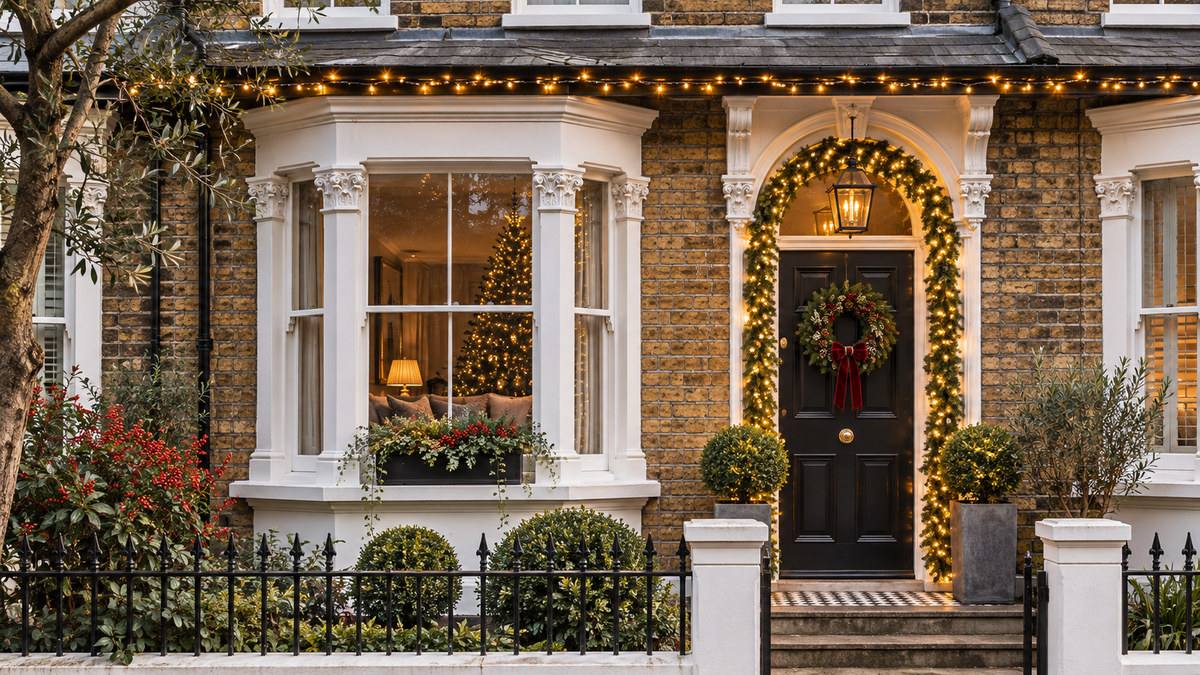
Warm white suits a brick or stone London front, and it is our standard. Cool white works on request for a modern white or grey front, where its blue edge matches the house.
The choice looks small, but it sets the whole mood of the street view. Below I explain how each colour reads against common London fronts, what the quote requests this season look like, and what to check if you buy your own lights.
What warm and cool white look like on a house
Warm white leans towards yellow and amber. Cool white leans towards blue. Put them side by side and the difference is obvious. On their own, either one can look right or wrong depending on what sits behind it.
A light does not glow in a vacuum. It lands on brick, stone, render, painted wood or a dark door, and the wall changes how the colour reads. A cool white string against warm red brick can look pale and thin. A warm white string against a bright white painted front can look dull and a little yellow.
So the question is less about which colour is nicer and more about which colour agrees with the house you have.
Why warm white is our standard on brick and stone
Warm white is our standard, and cool white or multicolour is available on request. We start from warm white because London fronts are so often made of brick, stucco or stone in earthy tones, and a warm light sits comfortably with those colours.
Warm white also keeps the display quiet. Gutters, door surrounds and railings pick up a soft glow rather than a sharp point of light. From the pavement the house looks lit, not decorated to shout.
That is a judgement about appearance, not a rule. If you like the crisp look of cool white and your house can carry it, say so and we will quote it that way.
When cool white is the better call
Cool white earns its place on fronts that are already cool in tone. Think of a modern extension in pale grey render, a white painted house, slate or grey cladding, or black and white window frames with no warm brickwork nearby.
Against those surfaces a warm light can clash and look slightly orange. A cool white string reads as clean and sharp, and it echoes the frosty look many people want from the season.
Mixing is where things go wrong. A cool gutter line over a warm lit door garland on the same front tends to look like a mistake rather than a plan. Pick one white for the whole front and keep to it.
What London quote requests look like this season
The quote requests we have received show how different the fronts are. A detached three-storey mock-Tudor house in IG8 asked for icicle lights along the main gutter, up and over the front gable and across the garage roof. I would expect warm white to suit a mock-Tudor front, but I would judge that from a photo of the house.
A stone-fronted Marylebone house in W1G asked for lights round a dark panelled door under a deep stone hood and along black railings on both sides of the front steps. Stone and dark paint are the kind of surfaces where warm white tends to give contrast without turning harsh.
A stucco-fronted house in SW6 asked for lights on the door surround, railings, balcony and lanterns across several floors. For that one, every light we priced was warm white, low voltage and run from a transformer plug with a built-in timer. Those are shop products we priced for the quote, which is a separate thing from our own stock.
All three were asks, not finished jobs, and each needs a proper quote at its own level.
If you buy your own lights: choosing the white and the electrics
Two products that both say warm white on the box can still look different once they are lit. If you are buying more than one set, light them together before you commit and compare the tone. Buy the same range for every white on the front where you can.
Look at the specification, not only the colour. Lights meant for a front door and railings should be outdoor rated, and low voltage sets run from a transformer plug with a timer are easy to find. The Health and Safety Executive's electrical safety pages say the risk of injury is generally greater with higher voltages and is dependent upon individual circumstances.
Outdoor lights and sockets should be rated for outdoor use. If you are unsure about your outdoor electrics, ask a registered electrician.
Our own lights are outdoor-rated, low-voltage LED on a timer. If a house has no outdoor socket, a weatherproof cable can be run to an indoor socket, so the colour decision does not depend on the socket.
Getting a quote in the colour you want
Tell us the colour when you ask. Warm white is the default and cool white is a request we can price. You can see the public packages and what each covers on our Christmas light installation page.
A photo helps us judge the colour against your front. Our note on photos for a Christmas lights quote explains what to send, and our Christmas light cost guide sets out how scope changes the quote.
To ask, send a photo of the front of the house and the postcode on WhatsApp: 07782 212334.